
What Will a 12,000 Watt Generator Run? (Complete Load Guide)
Updated: April 14, 2026
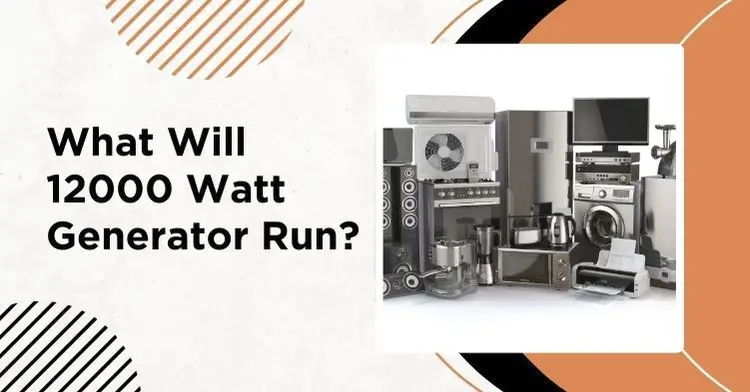
Quick answer: What will 12000 watt generator run? A 12,000-watt generator can run a central AC (up to 3 tons), a refrigerator, freezer, sump pump, lights, and most household appliances simultaneously. But there is a catch: 12,000 watts is the starting (peak) rating. The continuous running capacity is typically 9,000-9,500 watts, which is what actually determines what you can keep running at the same time.
What a 12,000 Watt Generator Still Will Not Do Comfortably
Even with 9,500W running capacity, a 12,000W generator has real limits that are worth understanding before you buy:
- Multiple 240V loads simultaneously: Central AC (3,200W) + electric dryer (5,400W) = 8,600W running. Add a sump pump startup and you are over the limit. Pick one 240V load at a time.
- Multiple motor startups at once: Even if total running watts are fine, two motors starting simultaneously can trip the overload. Always stagger startups.
- Efficient low-load operation: Running a 12,000W generator at 15-20% load (e.g., just a fridge and lights) wastes fuel. A smaller generator or inverter is more efficient for light loads. Some models have idle control or eco mode that helps, but fuel consumption at light load is still higher per watt than a right-sized generator.
- True whole-house backup: If your home has a heat pump, electric water heater, electric dryer, and central AC all on at once, you need a 16-22 kW standby generator connected to natural gas, not a 12,000W portable.
Knowing these limits up front prevents overloads, frustration, and potential damage to the generator or your appliances. For more on what to do when you exceed capacity, check our overloaded generator guide (linked below).
How to Check Your Appliance Nameplate
Do not rely on generic wattage tables alone. For accurate load planning, check the actual nameplate on each appliance:
- Refrigerator/Freezer: Look for the label inside the door or on the back. Find “Amps” and multiply by 120 to get running watts.
- Central AC: Find the condenser unit outside. Look for MCA (Minimum Circuit Amps) for running load and LRA (Locked Rotor Amps) for startup surge. Multiply each by 240V for watts.
- Well pump / Sump pump: Check the label on the motor or the breaker panel for the dedicated circuit amperage.
- Power tools / Welder: Check the input amps on the rating plate. Multiply by voltage (120V or 240V) for watts.
Nameplate data always beats generic estimates. If your loads add up to more than 80% of your generator’s running watts based on actual nameplate data, consider a larger generator or a soft-start device for your AC.
Important: 12,000 watts does not mean 12,000 watts of continuous power.
A “12,000-watt generator” delivers 12,000 watts for a few seconds during motor startup surges. The continuous (running) output is typically 9,000-9,500 watts. All the appliance combinations below are based on the running watts, not the peak rating. Check your specific model for its exact running wattage.
What will 12000 watt generator run? A 12,000-watt generator sits at the high end of portable generators, powerful enough to run most of a typical home during an outage. With 9,000-9,500 watts of continuous power, it handles central air conditioning, major appliances, and power tools that smaller generators cannot.
If you are asking what will 12000 watt generator run, this guide covers exactly that, with typical wattage estimates, a step-by-step load calculation method, and specific model references. Use these numbers as starting points and verify against your actual appliance nameplates.
What a 12,000 Watt Generator Can Run: Complete Appliance List
| Appliance | Running Watts | Starting Watts | Notes |
|---|---|---|---|
| Central AC (2-ton) | 2,000-2,500 | 5,000-7,000 | Most common residential size |
| Central AC (3-ton) | 2,900-3,500 | 10,500 | Startup surge uses most of your capacity |
| Central AC (4-ton) | 3,900-4,500 | 14,000 | Exceeds starting capacity, may not start |
| Refrigerator | 130-200 | 1,200 | Energy Star models. Older units may draw more; check data label. |
| Freezer | 50-100 | 500-1,000 | Low draw once running |
| Sump pump (1/2 HP) | 1,050 | 2,100 | Critical during storms |
| Well pump (1/2 HP) | 1,000 | 2,000 | Start alone, not with AC |
| Electric water heater | 4,500 | 4,500 | Resistive load, no additional surge above running watts |
| Clothes dryer (electric) | 5,400 | 6,750 | Cannot run with AC simultaneously |
| Washing machine | 1,150 | 2,250 | OK alongside most appliances |
| Dishwasher | 1,300-1,500 | 1,800 | With heating element |
| Microwave (1,000W) | 1,500 | 1,500 | Input power is higher than cooking watts |
| Window AC (10,000 BTU) | 1,500 | 2,200 | Smaller units draw less. Check nameplate. |
| LED lights (10 bulbs) | 80-100 | 0 | Negligible draw |
| TV + WiFi router | 150-250 | 0 | Low draw |
| Phone/laptop charging | 25-100 | 0 | Negligible |
| Space heater (1,500W) | 1,500 | 0 | No surge, but steady high draw |
| Air compressor (1 HP) | 1,600 | 4,500 | High startup surge |
| Circular saw | 1,400 | 2,300 | Intermittent use |
| Welder (MIG, 140A) | 2,300-2,900 | N/A (not a motor load) | Based on Hobart Handler 140: 20A/115V input, 2.9 kVA. Check your welder nameplate. |
How to Calculate Your Actual Load (4 Steps)
Do not guess. Use this method to figure out exactly what your 12,000W generator can handle in your specific home:
Step 1: List everything you want to run and its running watts. Check each appliance nameplate or use the table above as a rough starting point. Write down the running watts for each item.
Step 2: Add up all running watts. This is your total continuous load. It must stay below your generator’s running capacity (typically 9,000-9,500W for a 12,000W generator).
Step 3: Identify your largest single startup surge. Find the appliance with the highest starting watts that you will turn on while other things are already running. For the startup check, replace that appliance’s running watts in your total with its starting watts. The result must stay below 12,000W (peak capacity).
Step 4: Check the result.
- Total running watts under 7,600W (80% of 9,500W)? You have comfortable headroom.
- Total running watts 7,600-9,500W? It works, but stagger motor startups carefully.
- Total running watts over 9,500W? You need to rotate loads or get a larger generator.
- Running watts + largest startup surge over 12,000W? That appliance will not start while everything else is on. Start it first, alone.
Example: You want to run a 3-ton AC (3,200W running, 10,500W surge), fridge (200W), freezer (75W), sump pump (1,050W), and lights (80W). Total running = 4,605W. Largest surge = AC at 10,500W. Can the AC start with everything else running? 4,605 – 3,200 (AC not yet on) + 10,500 (AC surge) = 11,905W. That is under 12,000W peak, so yes, the AC can start. But if the sump pump kicks on at the same time as the AC starts: 10,500 + 2,100 = 12,600W, which exceeds peak. Solution: stagger them.
Simultaneous vs Staggered Startup: Why It Matters
Motor-driven appliances (AC, pumps, fridge) draw 2-5x their running watts for the first 1-3 seconds when starting. Two motors starting at the same moment can trip the overload even if their combined running watts are well within capacity.
Rule: Start only one motor-driven appliance at a time. Wait 5-10 seconds after the last motor settles before starting the next one. With this habit, your 12,000W generator handles far more than if you flip everything on at once.
Real-World Scenarios: What Can You Run Simultaneously?
The appliance table shows individual wattages. What matters is the total running watts of everything on at the same time plus the startup surge of the last thing you turn on.
Best practice: For comfortable headroom and engine longevity, try to keep your total load at or below 80% of running capacity. On a 9,500W running generator, that means staying under ~7,600 watts continuous.
Scenario 1: Home Backup with Central AC (3-ton)
| Appliance | Running Watts |
|---|---|
| Central AC (3-ton) | 3,200 |
| Refrigerator | 200 |
| Freezer | 75 |
| Sump pump | 1,050 |
| LED lights (10) | 80 |
| TV + WiFi | 200 |
| Phone charging | 25 |
| Total Running | 4,830W (51% of 9,500W capacity) |
Plenty of headroom. You can add a microwave or dishwasher one at a time without overloading. Do not start the AC and sump pump at the same time because their combined startup surge (10,500 + 2,100 = 12,600W) exceeds the peak capacity.
Scenario 2: Maximum Home Comfort (no central AC)
| Appliance | Running Watts |
|---|---|
| 2 window ACs | 2,400-3,000 |
| Refrigerator + Freezer | 275 |
| Well pump | 1,000 |
| Washing machine | 1,150 |
| Microwave | 1,500 |
| Lights + TV + WiFi + Phones | 400 |
| Total Running | 6,225-6,825W (66-72% capacity) |
Comfortable but approaching the limit. Do not add more motor-driven appliances without turning something off first.
Scenario 3: Job Site / Construction
| Tool | Running Watts |
|---|---|
| Air compressor (1 HP) | 1,600 |
| MIG welder (140A) | 3,000 |
| Circular saw | 1,400 |
| Drill press | 600 |
| Work lights | 500 |
| Total Running | 7,100W (75% capacity) |
Runs all common job site tools simultaneously. Watch compressor startup while the welder is under load because the compressor’s 4,500W surge added to the welder’s steady draw approaches the generator’s limit.
What a 12,000 Watt Generator Cannot Run
- Central AC 4-ton or larger: The startup surge (14,000W+) exceeds the 12,000W peak capacity. The compressor will not start.
- Electric dryer + central AC at the same time: Dryer alone draws 5,400W running. Adding 3,200W for AC = 8,600W. Close to the limit, and any motor startup pushes you over.
- Electric water heater + central AC: Water heater (4,500W) plus AC (3,200W) = 7,700W running, leaving almost no room for anything else.
- Whole house with everything on: A typical home with central AC, water heater, dryer, and all lights/outlets running draws 10,000-15,000W total. A 12,000W generator covers most loads, but not all of them at once. Base your planning on actual appliance nameplate data, not square footage.
Load Management: Tier 1, 2, 3 Priority System
During an outage, you do not need everything running at once. Use this priority system to stay within your generator’s capacity:
| Tier | Appliances | Running Watts | When |
|---|---|---|---|
| Tier 1: Always On | Fridge, freezer, lights, phones, WiFi, sump pump | ~1,500W | 24/7 |
| Tier 2: Rotate | Central AC OR well pump OR washing machine | +2,000-3,500W | One at a time |
| Tier 3: Brief Use | Microwave, dryer, water heater, power tools | +1,000-5,400W | Turn off Tier 2 first |
With this system, a 12,000W generator can handle most homes comfortably as long as you rotate heavy loads.
Special Cases: Heat Pump, RV AC, and Soft-Start
Furnace Blower / Heat Pump
A gas furnace blower motor draws 300-800 running watts with a 500-2,350W startup surge depending on blower horsepower. A 12,000W generator handles this easily alongside other loads. An electric heat pump (heating mode) draws 2,000-5,000W running depending on size, similar to central AC. Check the nameplate for your specific unit.
RV Air Conditioner
A standard RV rooftop AC (13,500-15,000 BTU) draws 1,800-2,000W running with a 2,800-3,300W startup surge (actual startup varies by model and whether a hard-start or soft-start kit is installed). A 12,000W generator can run 2-3 RV AC units simultaneously, making it suitable for large RVs and toy haulers with multiple AC units.
Soft-Start Devices for Central AC
A soft-start device reduces the AC compressor startup surge by 50-70%. MicroAir EasyStart specifically markets soft starters for running AC units on limited power sources like generators.
| AC Size | Normal Startup Surge | With Soft-Start | Savings |
|---|---|---|---|
| 2-ton | 5,000-7,000W | ~2,000-3,000W | 3,000-4,000W freed up |
| 3-ton | ~10,500W | ~4,000-5,000W | 5,500-6,500W freed up |
| 4-ton | ~14,000W | ~5,500-7,000W | May become startable on a 12,000W generator* |
*Actual reduction depends on the specific unit, altitude, temperature, generator transient response, and other loads running.
Without a soft-start, a typical 4-ton AC exceeds the 12,000W peak and will not start. With a soft-start, the surge may drop enough for the generator to handle it, but results vary by system. If you have a large AC and a portable generator, a soft-start device is worth investigating before assuming the generator cannot handle it.
Dual Fuel 12,000W Generators: Gas vs Propane Output
Several 12,000W generators offer dual fuel capability. Propane delivers less power than gasoline:
| Model | Running Watts (Gas) | Running Watts (Propane) | Loss |
|---|---|---|---|
| DuroMax XP12000EH | 9,500W | 9,025W | 5% |
| A-iPower SUA12000ED | 9,000W | 8,100W | 10% |
| WEN DF1200X | 9,500W | 9,000W | ~5% |
On propane, you lose 5-10% of running capacity. Plan your loads accordingly. For a full fuel comparison, check our propane vs gas generator guide.
Transfer Switch: Which Circuits to Include
To safely connect a 12,000W generator to your home panel, you need a transfer switch. Two common options:
- 50A whole-panel manual transfer switch or interlock kit: Powers your entire panel through the main breaker. You manage loads by turning individual breakers on and off. Works with the generator’s 14-50R 50A outlet.
- 30A essential-circuit transfer switch (8-10 circuits): Powers only selected circuits. Simpler to use during an outage because only your priority circuits are connected.
A licensed electrician should install either option. Central AC is a 240V two-pole load and may need dedicated load management.
If using an essential-circuit switch, here is a recommended circuit priority:
| # | Circuit | Why |
|---|---|---|
| 1 | Refrigerator | Food safety |
| 2 | Freezer | Food safety |
| 3 | Sump pump | Flood prevention |
| 4 | Well pump | Water supply |
| 5 | AC / furnace blower | Climate control |
| 6 | Kitchen outlets | Cooking, microwave |
| 7 | Bathroom | Lighting, GFCI outlets |
| 8 | Master bedroom | Lighting, medical devices |
| 9 | Living room | Lighting, TV, WiFi |
| 10 | Garage / utility | Washer, dryer option |
Never backfeed power into your panel without a transfer switch. Backfeeding sends power into utility lines and can electrocute line workers. It is illegal and extremely dangerous.
For sizing help, check our 100 amp service guide and 400 amp service guide.
30A vs 50A: Inlet, Cord, and Transfer Switch Explained
Connecting a 12,000W generator to your home involves matching three things: the generator outlet, the power cord, and the transfer switch or inlet box. Getting these wrong is a common and potentially dangerous mistake.
| Setup | 30A (L14-30) | 50A (14-50) |
|---|---|---|
| Generator outlet | L14-30R twist-lock | 14-50R (like a range outlet) |
| Max power delivery | 7,200W at 240V | 12,000W at 240V |
| Power cord | 10-gauge, 30A rated | Typically 6/3 + 8/1 copper cordset, 50A rated |
| Inlet box (on house) | L14-30P inlet | SS2-50P or CS6375 inlet |
| Transfer switch | 30A essential-circuit (8-10 circuits) | 50A whole-panel or interlock kit |
| Can run central AC? | Yes, but limited headroom | Yes, with full capacity |
| Best for | Essentials only during outages | Maximum use of generator capacity |
For a 12,000W generator, the 50A setup is recommended because the 30A connection limits you to 7,200W at 240V, wasting almost 25% of your generator’s capacity. If you already have a 30A inlet, it still works for essential loads, but you will not be able to use the full 9,500W running capacity through the panel.
Important: Never backfeed through a dryer outlet or any other method without a proper transfer switch or interlock kit installed by a licensed electrician. Backfeeding kills utility workers and is illegal.
How Many Amps Does a 12,000 Watt Generator Produce?
- At 120V: 12,000W / 120V = 100 amps (peak), ~79 amps running (9,500W)
- At 240V: 12,000W / 240V = 50 amps (peak), ~40 amps running
Most 12,000W generators include a 14-50R (50A) and/or L14-30R (30A) 240V outlet for connecting to a transfer switch, plus multiple 120V 20A outlets for direct use. Note: these amp figures are total generator output, not what any single receptacle can supply. Each outlet is limited by its own rating (20A for 5-20R, 30A for L14-30R, 50A for 14-50R).
How Long Will a 12,000 Watt Generator Run?
| Model | Tank Size | Runtime (50% load) | Fuel Use (50%) |
|---|---|---|---|
| DuroMax XP12000EH | 8.3 gal | ~8 hours | ~1.0 GPH |
| Westinghouse WGen9500DF* | 6.6 gal | ~8 hours (50%) | ~0.8 GPH |
| A-iPower SUA12000ED | 7 gal | 14 hours (25%)* | ~0.5 GPH (25%) |
*The WGen9500DF is rated at 12,500 peak / 9,500 running watts, slightly above the 12,000W class.
At 50% load, expect 8-9 hours per tank. At full load, that drops to 4-5 hours. With intermittent use (running essentials 8 hours/day), a single tank covers about one day. For extended outages, see our fuel shortage guide and continuous runtime guide.
What a 12,000 Watt Generator Still Will Not Do Comfortably
Even with 9,500W running capacity, a 12,000W generator has real limits that are worth understanding before you buy:
- Multiple 240V loads simultaneously: Central AC (3,200W) + electric dryer (5,400W) = 8,600W running. Add a sump pump startup and you are over the limit. Pick one 240V load at a time.
- Multiple motor startups at once: Even if total running watts are fine, two motors starting simultaneously can trip the overload. Always stagger startups.
- Efficient low-load operation: Running a 12,000W generator at 15-20% load (e.g., just a fridge and lights) wastes fuel. A smaller generator or inverter is more efficient for light loads. Some models have idle control or eco mode that helps, but fuel consumption at light load is still higher per watt than a right-sized generator.
- True whole-house backup: If your home has a heat pump, electric water heater, electric dryer, and central AC all on at once, you need a 16-22 kW standby generator connected to natural gas, not a 12,000W portable.
Knowing these limits up front prevents overloads, frustration, and potential damage to the generator or your appliances. For more on what to do when you exceed capacity, check our overloaded generator guide (linked below).
How to Check Your Appliance Nameplate
Do not rely on generic wattage tables alone. For accurate load planning, check the actual nameplate on each appliance:
- Refrigerator/Freezer: Look for the label inside the door or on the back. Find “Amps” and multiply by 120 to get running watts.
- Central AC: Find the condenser unit outside. Look for MCA (Minimum Circuit Amps) for running load and LRA (Locked Rotor Amps) for startup surge. Multiply each by 240V for watts.
- Well pump / Sump pump: Check the label on the motor or the breaker panel for the dedicated circuit amperage.
- Power tools / Welder: Check the input amps on the rating plate. Multiply by voltage (120V or 240V) for watts.
Nameplate data always beats generic estimates. If your loads add up to more than 80% of your generator’s running watts based on actual nameplate data, consider a larger generator or a soft-start device for your AC.
Safety reminders:
- Carbon monoxide: Run outdoors only, at least 20 feet from the home, not on a porch or in a carport, with exhaust pointed away from all doors, windows, and vents. Install battery-backed CO alarms on every level and outside sleeping areas. Close windows and seal vent openings near the generator or in the exhaust path (CPSC recommendation).
- Backfeed: Never plug into a wall outlet. Use a transfer switch installed by a licensed electrician.
- Refueling: Shut down and let cool before adding fuel.
- Overload: Stagger motor startups. Never start AC and sump pump simultaneously.
- Headroom: Keeping continuous load under 80% of running watts provides a safety margin for startup surges and extends engine life. This is a conservative best practice, not a hard manufacturer rule.
Will a 12,000 watt generator run a whole house?
It depends on the house and what you run simultaneously. A 12,000W generator (9,000-9,500W running) can power most of a typical home’s essential circuits (fridge, freezer, AC up to 3 tons, well pump, lights, and select outlets) including central AC (up to 3 tons), refrigerator, freezer, lights, and essentials. It cannot run everything at once in a larger home. Use load management to rotate heavy appliances like the dryer and water heater.
Can a 12,000 watt generator run central air conditioning?
Yes, up to a 3-ton central AC unit. A 3-ton AC draws about 3,200W running with a startup surge around 10,500W. The 12,000W peak capacity handles this surge. A 4-ton AC (14,000W startup) exceeds the generator’s peak capacity without a soft-start device. With a soft-start installed, some 4-ton systems may become workable. Verify against your condenser nameplate and test before relying on it.
How many amps does a 12,000 watt generator produce?
At 120V: up to 100 amps peak (79 amps continuous at 9,500W running). At 240V: up to 50 amps peak (40 amps continuous). Most 12,000W generators include both 120V and 240V outlets.
Can I run a welder on a 12,000 watt generator?
Yes. A MIG welder like the Hobart Handler 140 draws about 2,300-2,900 watts (20A input at 115V, 2.9 kVA rated). A 12,000W generator handles this with room for lights and a compressor. Larger welders (200A+) may exceed the running capacity depending on the duty cycle.
What size transfer switch do I need for a 12,000 watt generator?
Two options: a 50A whole-panel transfer switch or interlock kit (powers your full panel, you manage loads via breakers), or a 30A essential-circuit switch (8-10 pre-selected circuits). The 50A setup uses the full generator capacity. Have a licensed electrician install either option.
How long does a 12,000 watt generator run on a tank of gas?
Most 12,000W generators have 7-8.5 gallon tanks and run 8-9 hours at 50% load. At full load, expect 4-5 hours. Fuel consumption is roughly 0.8-1.0 gallons per hour at moderate load. With intermittent use during an outage, one tank covers about a day.
Related guides:
- What Will a 5500 Watt Generator Run?
- What Will a 7500 Watt Generator Run?
- How to Fix an Overloaded Generator
- Best Dual Fuel Generators
- How Long Can a Generator Run Continuously?
- Complete Power Outage Checklist
- How to Break In a Generator
- 13,000-watt portable generator picks
As an Amazon Associate I earn from qualifying purchases.