
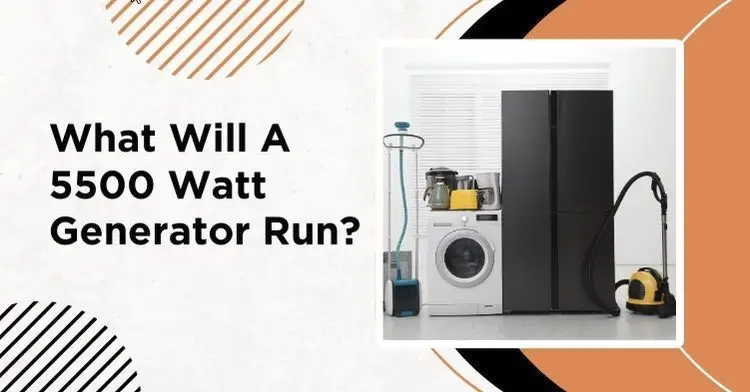
What Will A 5500 Watt Generator Run?
Updated: April 1, 2026
Quick answer: A 5500 watt generator can run most household essentials during a power outage, including a refrigerator, lights, TV, phone chargers, and a window AC unit or sump pump. The key is managing startup surges and not running everything at once. The exact running and starting watts vary by model, so always check your generator’s nameplate. This size generator covers the gap between small portable units and whole-house standby systems.
A 5500 watt generator is a popular choice for homeowners. Large enough to keep a house running during an outage, small enough to move and store in a garage. But the real question is not just what it can run, but what it can run at the same time.
This guide breaks down every common appliance by running and starting watts, walks through five real-world load scenarios with the math, and covers the tricky items like water heaters, window AC units, and welders that people ask about most.
Understanding Running Watts vs Starting Watts
Every appliance with a motor draws extra power for the first few seconds when it starts. This is called starting watts, surge watts, or inrush current. A 5500 watt generator varies by model:
- Some models are rated at 5,500 running watts with 6,500-7,000 surge watts
- Others are rated at 5,500 starting (surge) watts with 4,000-4,500 running watts
Always check both the running and starting watts on your specific model before planning your loads.
The running watts number is what matters for sustained operation. The starting watts give you headroom for motor startups. When planning your loads, add up the running watts of everything you want to power. When a motor-driven appliance starts, its running watts are temporarily replaced by its starting watts. The peak demand equals: (total running watts) minus (starting appliance running watts) plus (starting appliance surge watts).
For more on what happens when you exceed your generator’s capacity, see our guide on how to fix an overloaded generator.
Electrical Output: Amps and Voltage
A generator rated at 5,500 running watts at 120V can deliver up to approximately 45.8 amps (5500 / 120 = 45.8). At 240V, that is about 22.9 amps. However, individual outlet breakers (typically 20A or 30A) limit the current available at each receptacle. Check your generator’s outlet ratings. The 240V outlet is needed for large appliances like electric dryers, water heaters, and some welders.
What Will a 5500 Watt Generator Run? Complete Appliance Tables
The tables below show typical wattage ranges based on manufacturer specifications and industry data. Actual consumption varies by brand, model, age, and condition. When in doubt, check the nameplate on your appliance or use a Kill A Watt meter to measure real consumption.
Kitchen Appliances
| Appliance | Running Watts | Starting Watts |
|---|---|---|
| Refrigerator | 100-400 | 1,200 |
| Freezer (chest or upright) | 100-400 | 1,200 |
| Microwave (1,000W cooking power) | 1,500 | 1,500 |
| Coffee maker (drip) | 600-1,200 | 600-1,200 |
| Toaster (2-slice) | 800-1,500 | 800-1,500 |
| Electric stove (single burner) | 1,500 | 1,500 |
| Dishwasher | 1,200-1,500 | 1,200-1,500 |
| Blender | 300-700 | 300-700 |
| Slow cooker | 200-300 | 200-300 |
| Instant Pot / Pressure cooker | 700-1,000 | 700-1,000 |
Note: Microwaves are labeled by cooking power (e.g., “1000W microwave”), but the actual electrical input is higher, typically around 1,500W.
HVAC and Climate Control
| Appliance | Running Watts | Starting Watts |
|---|---|---|
| Window AC (5,000 BTU) | 500 | 1,500 |
| Window AC (8,000 BTU) | 800-1,000 | 2,400-3,000 |
| Window AC (10,000 BTU) | 1,200 | 3,000-3,600 |
| Window AC (12,000 BTU) | 1,400 | 3,600-4,200 |
| Portable AC (10,000 BTU) | 1,100-1,300 | 2,800-3,600 |
| Space heater (electric) | 1,500 | 1,500 |
| Gas furnace blower (1/2 HP) | 800 | 2,350 |
| Dehumidifier | 300-700 | 600-1,400 |
| Portable fan (box fan) | 50-100 | 50-100 |
| Ceiling fan | 60-120 | 60-120 |
Can a 5500 watt generator run central air conditioning? In most cases, no. A typical 2-ton central AC draws 2,400-3,500 running watts with startup surges that can reach 6,000-7,000W or more depending on the unit. A 3-ton unit surges to 7,000W+, which exceeds even the starting capacity of a 5500W generator. Window AC units up to 12,000 BTU can work depending on the specific unit and generator model. A 12,000 BTU window AC typically draws 1,000-1,400W running with a 3,600-4,200W startup surge, which fits within most 5500W generators’ starting capacity. Check your specific AC unit’s nameplate data. For central AC requirements, see our guide on what size generator for a 5-ton AC.
Water and Pumps
| Appliance | Running Watts | Starting Watts |
|---|---|---|
| Electric water heater (4,500W element) | 4,500 | 4,500 |
| Well pump (1/2 HP) | 1,000 | 2,100 |
| Sump pump (1/3 HP) | 800 | 1,300 |
| Sump pump (1/2 HP) | 1,050 | 2,150 |
Laundry and Household
| Appliance | Running Watts | Starting Watts |
|---|---|---|
| Washing machine | 500-1,000 | 1,150-2,300 |
| Electric dryer (240V) | 5,400 | 5,400 |
| Iron | 1,000-1,500 | 1,000-1,500 |
| Hair dryer | 1,000-1,800 | 1,000-1,800 |
| Vacuum cleaner | 500-1,200 | 500-1,200 |
| Garage door opener (1/2 HP) | 550 | 1,100 |
Note on electric dryers: A standard electric dryer draws around 5,400W continuously. This only works on a 5500W generator that is rated for 5,500 running (continuous) watts. If your generator’s running watts are lower (e.g., 4,500W), it cannot sustain a dryer. Check your generator’s rated watts before attempting this. Gas dryers use only 300-600W for the drum motor and controls.
Entertainment and Electronics
| Appliance | Running Watts | Starting Watts |
|---|---|---|
| LED TV (55 inch) | 80-120 | 80-120 |
| Laptop | 50-100 | 50-100 |
| Desktop computer + monitor | 200-400 | 200-400 |
| WiFi router + modem | 15-30 | 15-30 |
| Phone charger | 5-25 | 5-25 |
| Gaming console | 100-200 | 100-200 |
| 10 LED light bulbs | 100 | 100 |
Power Tools
| Tool | Running Watts | Starting Watts |
|---|---|---|
| Circular saw (7-1/4 inch) | 1,400 | 2,400 |
| Miter saw (10 inch) | 1,400-1,800 | 2,400-3,000 |
| Table saw | 1,800 | 3,000-4,500 |
| Air compressor (1 HP) | 1,600 | 4,500 |
| Drill (1/2 inch) | 600 | 900 |
| Reciprocating saw | 1,000 | 1,300 |
| Angle grinder (4-1/2 inch) | 900 | 1,400 |
| Belt sander | 1,200 | 2,400 |
| Shop vac (6 gallon) | 700-1,400 | 1,400-2,000 |
A 5500 watt generator handles most individual power tools with room to spare. The exception is a large air compressor, which can surge to 4,500W at startup. If you are running multiple tools on a job site, stagger their startups. For tips on managing surges, see our generator overload troubleshooting guide.
Five Real-World Scenarios: What Can Run Simultaneously?
Numbers in a table are useful, but what matters is what you can actually run at the same time. Each scenario below shows the math.
Scenario 1: Power Outage Essentials
| Appliance | Running Watts |
|---|---|
| Refrigerator | 200 |
| Chest freezer | 200 |
| 10 LED lights | 100 |
| TV + WiFi router | 150 |
| 2 phone chargers | 30 |
| Portable fan | 75 |
| Total running | 755W |
| Highest startup (refrigerator) | 1,200W |
| Peak demand | 1,755W |
Verdict: Easily handled. You still have over 3,700W of headroom for additional loads. This is the baseline for any power outage.
Scenario 2: Outage Essentials + Window AC (Summer)
| Appliance | Running Watts |
|---|---|
| All essentials from Scenario 1 | 755 |
| Window AC (10,000 BTU) | 1,200 |
| Total running | 1,955W |
| AC startup surge (replaces 1,200W running) | +2,400W net |
| Peak demand | 4,355W |
Verdict: Right at the limit. The AC startup surge adds about 2,400W net above its running draw (3,600W surge minus 1,200W running). Total peak reaches about 4,355W, which fits within the starting capacity. However, if a second motor kicks on during the AC startup, the combined surge could approach the limit. Stagger your startups.
Scenario 3: Outage Essentials + Sump Pump (Storm)
| Appliance | Running Watts |
|---|---|
| All essentials from Scenario 1 | 755 |
| Sump pump (1/3 HP) | 800 |
| Gas furnace blower | 800 |
| Total running | 2,355W |
| Furnace blower startup (replaces 800W running) | +1,550W net |
| Peak demand | 3,905W |
Verdict: Comfortable fit. A winter storm setup with furnace blower, sump pump, and all essentials stays well within the 5500W capacity.
Scenario 4: Kitchen Setup
| Appliance | Running Watts |
|---|---|
| Refrigerator | 200 |
| Microwave | 1,500 |
| Coffee maker | 1,000 |
| Lights | 100 |
| Total running | 2,800W |
Verdict: Works fine. But do not add a toaster or electric stove while the microwave and coffee maker are running. Those resistive loads stack fast.
Scenario 5: Job Site / Workshop
| Tool | Running Watts |
|---|---|
| Circular saw | 1,400 |
| Drill | 600 |
| Work lights | 200 |
| Radio | 50 |
| Total running | 2,250W |
| Circular saw startup (replaces 1,400W running) | +1,000W net |
| Peak demand | 3,250W |
Verdict: Works well for most hand tools. Avoid running a circular saw and air compressor at the same time, as the combined startup can exceed 5,500W.
Can a 5500 Watt Generator Run a Water Heater?
Yes, but that is essentially all it will do. A standard 40-gallon electric water heater uses a 4,500W heating element. That leaves only about 1,000W for anything else. Running a water heater alongside a refrigerator and lights is possible, but adding any motor-driven appliance risks an overload.
A better approach during an outage: heat water in batches. Run the water heater for 20-30 minutes (enough to partially reheat the tank), then switch it off and power other appliances. Repeat as needed.
Gas water heaters are a different story. They use only about 200-400W for the gas valve, thermostat, and controls, leaving plenty of generator capacity for other loads.
Can a 5500 Watt Generator Run a Welder?
It depends on the welder type and amperage:
- Small MIG welder (90-140 amp, 120V): Draws 2,000 to 3,500W running. Works on a 5500W generator, but you cannot run much else simultaneously.
- Stick welder (up to 160 amp, 120V): Draws 2,500 to 4,000W running. Workable on a 5500W generator for light-duty welding.
- Large 240V welder (200+ amp): Exceeds 5500W. Requires a larger generator (8,000-10,000W or more).
If welding is your primary use, look for a generator specifically rated for welding. Some 5500W models have a 240V outlet that can handle smaller welders. For detailed sizing, see our guide on what size generator for a welder.
What a 5500 Watt Generator Cannot Run
Some appliances either exceed the capacity or consume so much that nothing else can run alongside them:
- Central air conditioning (2+ ton): Startup surge of 4,800-7,000W+ exceeds capacity
- Electric range/oven (full): Can draw 3,000-5,000W, leaving no room for anything else
- Electric dryer + other loads: The dryer alone uses 5,400W
- Large 240V welder (200+ amp): Exceeds capacity
- Whole house simultaneously: A typical house draws 5,000-10,000W during normal use
How to Manage Your Loads
The key to getting the most out of a 5500W generator is load management:
- Start motor-driven appliances one at a time. Wait for the refrigerator compressor to settle before turning on the AC or sump pump.
- Stagger high-draw appliances. Run the microwave, then turn it off before using the coffee maker or toaster.
- Prioritize essentials. Refrigerator, lights, and charging always come first. AC, cooking, and laundry come second.
- Know your biggest loads. Window AC, space heater, microwave, and hair dryer are the usual suspects that push you over the limit.
For more on protecting your devices from generator power fluctuations, see our guide on making a generator safe for electronics.
Generator Runtime and Fuel Efficiency
Most 5500W generators have a 4 to 7 gallon fuel tank and run 8 to 12 hours at 50% load. At full load, runtime drops to 4 to 6 hours. Running at 50-75% load is more fuel efficient and extends engine life.
For detailed runtime data, check our 5 gallons runtime guide and our generator continuous runtime guide.
Safety Tips
Generator Safety:
- Always run generators outdoors, at least 20 feet from windows, doors, and vents. Carbon monoxide from exhaust is odorless and deadly. Never run a generator in a garage, carport, basement, shed, or on a porch, even with doors open.
- Point the exhaust away from the house and any occupied areas.
- Install battery-operated CO detectors on every level of the house and outside sleeping areas.
- Never backfeed a generator into a wall outlet. Use a transfer switch installed by a licensed electrician, or plug appliances directly into the generator using heavy-duty outdoor-rated extension cords.
- Let the generator cool before refueling. Gasoline on a hot exhaust causes fires.
- Use a GFCI-protected outlet or adapter, especially in wet conditions.
- Protect the generator from rain and snow with a canopy or running cover while maintaining full ventilation.
For storm-specific preparation, see our complete power outage checklist and tornado season generator guide.
Frequently Asked Questions
Will a 5500 watt generator run a whole house?
Not an entire house at once. A typical home draws 5,000-10,000W during normal use. A 5500W generator covers the essentials: refrigerator, freezer, lights, TV, fans, phone charging, and one window AC unit or sump pump. You will need to manage loads and avoid running multiple high-draw appliances simultaneously.
Can a 5500 watt generator run a refrigerator and AC at the same time?
Yes, a 5500W generator can run a refrigerator (100-400W running) and a window AC up to 10,000 BTU (1,200W running) at the same time. The combined running load is about 1,600W. During AC startup, the peak is approximately 4,000W (other running loads minus AC running watts plus AC surge). This fits within most 5500W generators’ starting capacity but leaves little margin. Start the AC first, let it settle, then plug in the refrigerator.
How many amps does a 5500 watt generator produce?
At 120V, a 5500W generator produces approximately 45.8 amps (5500 / 120 = 45.8). At 240V, it produces about 22.9 amps. Most 5500W generators have both 120V and 240V outlets.
Is a 5500 watt generator safe for sensitive electronics?
Standard open-frame 5500W generators produce power with higher Total Harmonic Distortion (THD), typically 10-15%, which can affect sensitive electronics over time. A surge protector helps with voltage spikes but does not fix THD. For computers, medical equipment, and other sensitive devices, an inverter generator (under 3% THD) or a UPS (uninterruptible power supply) between the generator and your equipment provides cleaner power.
Can a 5500 watt generator run a well pump?
Yes. A typical 1/2 HP well pump draws about 1,000 running watts with a 2,100W startup surge. This is well within a 5500W generator’s capacity, even with other loads running. A 1 HP well pump draws about 2,000W running with a 4,000W surge, which also works but leaves less room for other appliances.
What is the difference between 5500 starting watts and 5500 running watts?
Starting watts (also called surge or peak watts) is the brief burst of power available for motor startups, lasting a few seconds. Running watts (also called rated watts) is the continuous power the generator can sustain. A “5500 watt generator” can mean different things: some have 5,500 running watts with higher surge capacity, others have 5,500 starting (surge) watts with lower continuous output. Always check both the running and starting watts on the nameplate before buying.
Knowing what a 5500 watt generator will run helps you plan for outages, job sites, and outdoor events. The key takeaway: add up your running watts, account for the biggest startup surge, and stay below the generator’s rated capacity. Manage your loads, and a 5500W generator covers far more than most people expect.
As an Amazon Associate I earn from qualifying purchases.