
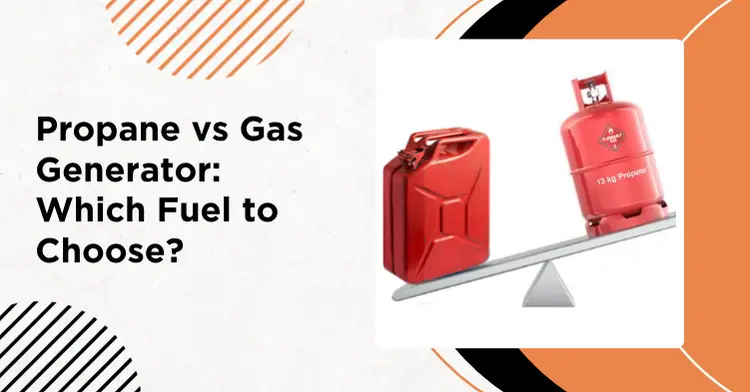
Propane vs Gas Generator in 2026: Fuel Cost, Runtime, Safety, and the Best Fuel During Shortages
Updated: September 24, 2026
Quick answer: During the 2026 fuel crisis, propane is the safer bet for generator fuel. It stores indefinitely, is often still available when gas stations run dry, and burns cleaner. Gasoline has about 31% more energy per gallon than propane, but on real dual-fuel generators the output difference is typically ~5-15% more running wattage on gasoline. Gasoline can also begin to go stale in as little as ~30 days (especially ethanol blends) and becomes scarce during shortages. A dual fuel generator that runs on both gives you the most flexibility. If you already own a gas-only generator and can still find gasoline, stick with it and add fuel stabilizer. If you are buying new, go dual fuel.
Fuel prices, runtime specs, and market disruption context verified against AAA, EIA, CPSC, PERC, and current manufacturer specs (Champion 201393, DuroMax XP5500EH, Westinghouse WGen5300DFc), as of April 20, 2026.
With gas prices up roughly 35% since late February 2026 ($2.98 on Feb 26 → $4.042 on Apr 20, per AAA) and fuel shortages affecting multiple states, the choice between propane and gasoline for your generator is no longer just about preference. It is about which fuel you can actually get and how long your supply will last.
This propane vs gas generator guide compares the two fuels across every factor that matters during a fuel crisis: cost per kilowatt-hour at current prices, runtime per gallon, shelf life, availability, safety, and environmental impact. It also covers natural gas as a third option and recommends specific dual fuel generators for different budgets.
Propane vs Gas Generator: Quick Comparison
| Factor | Gasoline | Propane (LP) | Natural Gas |
|---|---|---|---|
| Energy content | ~120,000 BTU/gal (EIA) | ~91,500 BTU/gal (EIA) | ~1,036 BTU/ft³ (EIA; 100 ft³ ≈ 103,600 BTU; 1 therm ≈ 100,000 BTU) |
| Power output | Baseline (100%) | ~5-15% less | ~15-20% less (model-dependent) |
| Shelf life | Can stale in ~30 days (esp. ethanol blends); stabilizer extends it – follow manufacturer storage procedure | Indefinite (PERC) | Unlimited (utility line) |
| Current price (Apr 20, 2026) | $4.042/gal (AAA national avg) | ~$2.67/gal (EIA residential, Mar 2026); retail exchanges often $3-4 | ~$13.94 per 1,000 ft³ (EIA residential; ~$1.39 per 100 ft³) |
| Availability during shortage | Scarce (pumps need electricity) | Often still available | No on-site storage; usually continuous, but utility interruptions are possible |
| Storage safety | Flammable vapors, spill risk | Sealed cylinder, no spill risk like gasoline, but leaks release heavier-than-air vapor | No storage needed |
| CO&sub2; per energy unit | 167.79 lb CO&sub2;/MMBtu (EIA) | 138.63 lb CO&sub2;/MMBtu (EIA; ~17% less than gasoline) | 116.65 lb CO&sub2;/MMBtu (EIA; lowest of the three) |
| Cold weather starting | Good (with fresh fuel) | Output and vaporization rate drop as temperatures fall; small cylinders lose performance sooner (boiling point -44°F) | Excellent |
| Maintenance | More (carburetor gumming) | Less (cleaner burn) | Least |
| Best for | Short outages, available fuel | Extended outages, fuel shortages | Homes with gas line |
Why the 2026 Fuel Crisis Changes the Equation
In normal times, gasoline wins on cost and power output. You drive to a gas station, fill a can for a few dollars, and your generator runs at full rated capacity.
The current situation is different. Per EIA, nearly 20% of global oil supply flows through the Strait of Hormuz, and the April 2026 disruption has moved U.S. gasoline prices from $2.98/gal on February 26 to $3.98/gal on March 26 (AAA), reaching $4.042/gal on April 20, 2026 (AAA national average). EIA tracked U.S. diesel at $5.608/gal in its weekly update on April 13, 2026. Multiple states are experiencing spot shortages, and gas stations in affected areas have lines or run out entirely.
Propane supply has been less affected. Most U.S. propane is produced domestically, primarily from natural gas processing, with additional supply from oil refining (EIA; PERC), making it less dependent on imported crude oil. While propane prices have increased, availability has remained more stable than gasoline in most areas.
Bottom line: the best fuel is the one you can actually get.
For a detailed guide on stretching your fuel supply during the crisis, see our generator fuel shortage survival guide.
Propane Generators: Advantages During a Fuel Shortage
1. Indefinite Shelf Life
Propane does not degrade (PERC). A sealed propane tank purchased today works just as well in five years. Gasoline, by contrast, can begin to go stale in as little as ~30 days – especially ethanol blends – without stabilizer. For storage beyond 30 days, follow the generator manufacturer’s storage procedure and add fuel stabilizer, which typically extends usable life to roughly 12-18 months depending on conditions.
This makes propane the better stockpile fuel. You can buy tanks now and store them for the next crisis without worrying about fuel going stale.
2. Available When Gas Stations Are Empty
Gas stations need electricity to pump fuel. During a widespread power outage, many stations cannot operate. Even when they have power, supply disruptions can leave them dry for days.
Propane is distributed differently. Propane may remain available through tank exchanges (Blue Rhino, AmeriGas) at hardware stores, grocery stores, gas stations, or home delivery during a gasoline shortage, depending on local conditions. Propane delivery services can refill larger tanks at your home. And if you already have propane tanks on hand, you are not dependent on any supply chain at all.
3. Cleaner Burn, Less Maintenance
Propane burns cleaner than gasoline. By EIA emission coefficients, propane produces about 17% less CO&sub2; per BTU (138.63 vs 167.79 lb CO&sub2;/MMBtu). Specific CO reductions for portable generators vary by model and load – broad percentages from automotive or fleet contexts do not transfer one-to-one. For generator owners, the practical benefit is less carbon buildup in the engine, which means less maintenance over time. Gasoline generators that sit unused between outages often develop carburetor problems from fuel gumming. Propane generators do not have this issue.
4. Safer to Store
Gasoline produces flammable vapors at room temperature. A spill near an ignition source can cause a fire. Propane is stored in sealed, pressurized cylinders, so there is no open-air spill risk like gasoline. Note that leaks can release heavier-than-air vapor, so always leak-test connections and store tanks outdoors. For households stockpiling fuel during a crisis, propane is significantly safer than keeping multiple gas cans in a garage or shed.
Gasoline Generators: When They Still Make Sense
1. More Power Per Gallon
Gasoline contains about 120,000 BTU per gallon compared to propane’s 91,500 BTU. In practice, most dual fuel generators produce about 5-15% fewer running watts on propane compared to gasoline. If fuel supply is not an issue, gasoline gives you more hours of power per dollar.
2. Lower Upfront Cost
Gas-only generators are often cheaper in comparable classes (retail spread varies by brand and season). If budget is tight and gasoline is available in your area, a gas-only generator still works.
3. Easier Cold Weather Starting
Gasoline generators start more reliably in extreme cold. Propane tank pressure drops as temperatures fall. The boiling point of propane is -44°F, but practical problems start well above that because vapor pressure and vaporization rate decline with temperature, cylinder size, fill level, and load. Smaller tanks (20 lb) lose output sooner than larger ones. In cold climates, use a larger cylinder or manifold two tanks, keep tanks above freezing where possible, and reduce load during cold starts.
Runtime Comparison: Same Generator, Different Fuel
Most dual fuel generators show a noticeable difference in runtime between gasoline and propane:
| Generator | Gas Runtime (50% load) | Propane Runtime (50% load) | Difference |
|---|---|---|---|
| Champion 4750/3800W Dual Fuel (201393) | ~14 hours (4.7 gal tank) at 50% load | ~10.5 hours (20 lb tank) at 50% load | Gas longer per fill on current model |
| DuroMax XP5500EH | ~9 hours (4 gal tank) | ~8 hours (20 lb tank) | Gas slightly longer |
| Westinghouse WGen5300DFc Dual Fuel | ~11 hours (4.7 gal tank) at 50% | ~9 hours (20 lb tank) at 50% | Gas ~20% longer |
Propane tanks are quick to swap though. When one 20-pound tank runs out, you disconnect it and connect a fresh one in under a minute. Keep 2-3 tanks on hand and the shorter runtime per tank becomes less of an issue.
For detailed runtime data by generator model, check our runtime on 5 gallons guide and our continuous runtime guide.
Cost Per Kilowatt-Hour at Current 2026 Prices
Here is what each fuel type actually costs to run your generator right now:
| Fuel | Current Price (Apr 20, 2026) | Energy content (EIA) | Approx. Cost per kWh* | 24h cost at 1.75 kW avg (3,500W-class at 50%)* |
|---|---|---|---|---|
| Gasoline | $4.042/gal (AAA) | ~120,000 | $0.65-0.85 | ~$27-36 |
| Propane | $2.67/gal EIA residential (Mar 2026); retail often $3-4 | ~91,500 | $0.65-1.00 | ~$27-42 |
| Natural Gas | ~$1.39 per 100 ft³ (EIA residential) | ~1,036 BTU/ft³ (so ~103,600/100 ft³) | $0.20-0.35 | ~$8-15 |
*Cost/kWh ranges are estimates derived from EIA fuel energy content, runtime data from current manufacturer specs (Champion 201393, DuroMax XP5500EH, Westinghouse WGen5300DFc in the 3,500-5,500W class deliver roughly 5-6 kWh electrical output per gallon of gasoline at 50% load), and April 2026 retail prices. Actual cost depends on specific model, load, and local fuel pricing. Prices and disruption context checked against AAA/EIA data current as of April 20, 2026.
Gasoline is still slightly cheaper per kWh than propane, but the gap has narrowed with rising gas prices. Natural gas is by far the cheapest option for homes with a utility gas line. The real cost difference during a shortage is not price per gallon but whether you can get fuel at all.
Natural Gas: The Third Option
If your home has a natural gas utility connection, natural gas is your most reliable option. Natural gas flows through underground pipes from the utility, unaffected by gas station closures or delivery disruptions.
The downsides: natural gas generators used for whole-home backup are typically permanently installed standby units ($3,000-$7,000+ installed), not portable. Natural gas typically produces ~15-20% less power than gasoline on the same engine (verified from current Champion and Westinghouse dual/tri-fuel specs). Supply is practically unlimited as long as the utility keeps operating, though utility natural gas can be interrupted during major storms (Generac guidance).
For homes with natural gas, a standby generator eliminates fuel shortage concerns entirely. Our 100 amp service guide and 5500 watt generator guide cover sizing in detail.
Dual Fuel Generators: The Best Choice for 2026
A dual fuel generator runs on both gasoline and propane, with a switch or selector to choose between them. During normal times, use the cheaper gasoline. During a shortage, switch to propane. That flexibility matters when you cannot predict which fuel will be available next week.
Recommended Dual Fuel Generators
For home essentials (fridge, lights, phone, sump pump):
Champion 4750/3800W Dual Fuel runs on both gasoline and propane, includes a 20-lb propane hose, and handles the essentials for a typical household. Quiet operation and reliable starting.
For larger loads (fridge + window AC + well pump):
DuroMax XP5500EH Dual Fuel offers 5,500 starting watts on gasoline, enough for multiple appliances. Heavy-duty build with both 120V and 240V outlets.
For whole-house essentials:
Westinghouse WGen5300DFc Dual Fuel provides 5,300 running watts on gasoline with a 4.7-gallon tank. RV-ready with a TT-30R outlet.
How to Switch from Gas to Propane on a Dual Fuel Generator
If you own a dual fuel generator and have never used propane mode, here is the process:
- Turn the generator off and let it cool.
- Connect the propane hose (included with most dual fuel generators) to the generator’s propane inlet and to the propane tank valve.
- Set the fuel selector to “LPG” or “Propane” (location varies by model, check your manual).
- Open the propane tank valve slowly (turn counterclockwise).
- Start the generator using the normal starting procedure (recoil or electric start).
- Let it warm up for 1-2 minutes before connecting loads.
Do not run the generator on both fuels simultaneously. Always select one fuel source before starting. If switching fuels, turn off the generator, switch the selector, and restart.
How Much Propane to Keep on Hand
| Tank Size | Propane Volume | Runtime (3,500W-class at 50% load, ~1.75 kW avg) | Days with Intermittent Use |
|---|---|---|---|
| 20 lb (standard BBQ) | ~4.7 gallons | 8-12 hours continuous | 1-2 days |
| 30 lb | ~7 gallons | 12-18 hours continuous | 2-3 days |
| 40 lb | ~9.4 gallons | 16-24 hours continuous | 3-4 days |
| 100 lb | ~23.5 gallons | 40-60 hours continuous | 7-10 days |
Propane tank runtime is a planning estimate; actual runtime varies by generator model, load, and cylinder fill level. Use manufacturer specs for your specific generator.
For a typical household running essentials intermittently (6 hours/day), three 20-pound tanks cover about 4-6 days. Keep at least two tanks full at all times and refill or exchange empty tanks before the next storm or shortage.
Store propane tanks outdoors, upright, on a flat surface, away from heat sources and building openings. Propane tanks are designed for outdoor storage and handle temperature extremes well.
Safety: Propane vs Gasoline Storage
Both fuels require safe handling:
- Gasoline: Store in approved containers only (approved gas cans). Never store indoors. Vapors are heavier than air and collect at ground level near ignition sources. Add fuel stabilizer for storage beyond 30 days.
- Propane: Keep tanks upright, outdoors, away from heat. Never store propane tanks indoors or in enclosed spaces. Check tank valves for leaks using soapy water (bubbles indicate a leak). Do not use damaged or rusted tanks.
- Propane extra: After connecting a new tank, test fittings with soapy water (bubbles mean a leak). Small cylinders must have an OPD (Overfill Protection Device) valve. Propane vapors are heavier than air and can collect in low-lying areas.
- Backfeed warning: Never plug a generator into a wall outlet. Backfeeding is extremely dangerous and not code-compliant unless the generator is connected through a proper transfer switch or approved interlock installed per code (CPSC). It can electrocute utility lineworkers and neighbors. Our generator sizing guide covers transfer switch options.
- Both: Run the generator outside only, at least 20 feet from the house, and do not use on a porch or in a carport. Direct exhaust away from your home and any other building entrances, and close windows or seal vents near the generator or in the exhaust path (CPSC). Install CO alarms on each level of the home and outside separate sleeping areas; interconnected alarms are best.
Propane vs Gas Generator: Which Fuel Should You Choose Right Now?
| Your Situation | Best Choice | Why |
|---|---|---|
| Gas stations in your area are running out | Propane | Available at hardware stores, tank exchanges, delivery services |
| Gas is available but expensive | Gasoline (short term) | Still cheaper per kWh, more power per gallon |
| You want to prepare for the next shortage | Dual Fuel generator + propane stockpile | Use gas when cheap, switch to propane when scarce |
| Your home has a natural gas line | Natural gas standby generator | Unlimited fuel, automatic operation, no refueling |
| You have a gas-only generator now | Gasoline + stabilizer + propane conversion kit | Use what you have, add propane capability later |
Frequently Asked Questions
Is propane or gasoline cheaper to run a generator?
At current April 2026 prices, gasoline runs about $0.65-0.85 per kilowatt-hour, while propane ranges roughly $0.65-1.00 per kWh depending on whether you pay EIA residential rates or retail exchange prices. The gap has narrowed significantly with gas prices up roughly 35% since late February. Natural gas is the cheapest option at roughly $0.20-0.35 per kWh for homes with a utility connection. During an actual shortage, propane may be the only fuel you can get, making cost comparisons irrelevant.
Can I convert my gasoline generator to run on propane?
Yes, propane conversion kits are available for many gasoline generators. These kits add a propane inlet and regulator to your existing generator. However, converting a generator to dual fuel should be done carefully and following the kit manufacturer’s instructions. Not all generators are compatible, and improper installation can void your warranty or create safety hazards. If you are buying new, a factory dual fuel generator is a better choice.
How long does a 20-pound propane tank last on a generator?
A standard 20-pound propane tank (about 4.7 gallons) lasts roughly 8-12 hours on a 3,500W-class generator at 50% load (~1.75 kW average draw). Larger generators use more propane and run shorter. With intermittent use (running 6 hours per day for essentials only), one 20-pound tank can cover 1-2 days.
Does propane damage a generator engine?
No. Propane actually produces less engine wear than gasoline because it burns cleaner, leaving less carbon buildup on valves and spark plugs. Propane does burn slightly hotter, but modern dual fuel generators are designed to handle both fuels without premature wear. Many propane users report longer intervals between maintenance compared to gasoline-only operation.
Where can I buy propane during a fuel shortage?
Propane is available through tank exchanges (Blue Rhino, AmeriGas) at hardware stores, grocery stores, and gas stations. Propane delivery services can refill larger tanks at your home. Local propane dealers often maintain stock even during gasoline shortages because propane supply chains are largely domestic and separate from gasoline distribution.
Should I buy a dual fuel generator because of the fuel crisis?
If you do not already own a generator and are buying one now, a dual fuel model is the best choice. The added cost of dual-fuel (often a modest premium over comparable gas-only models) gives you the ability to run on whichever fuel is available. If gasoline shortages continue or worsen, that flexibility could be the difference between having power and not. Even after this crisis passes, dual fuel capability provides insurance against future fuel disruptions from hurricanes, winter storms, or supply chain issues.
The propane vs gas generator debate normally comes down to personal preference. During a fuel crisis, it comes down to availability. Propane stores indefinitely, is produced domestically, and remains accessible when gas stations cannot pump. Gasoline delivers more power per gallon but becomes useless when you cannot get it. A dual fuel generator eliminates the need to choose.
Related guides:
- How to Run a Generator During a Fuel Shortage
- How Long Can a Generator Run Continuously?
- How Long Will a Generator Run on 5 Gallons of Gas?
- Solar Generator vs Gas Generator for Camping
- Complete Power Outage Checklist
As an Amazon Associate I earn from qualifying purchases.
Last updated: April 20, 2026.