
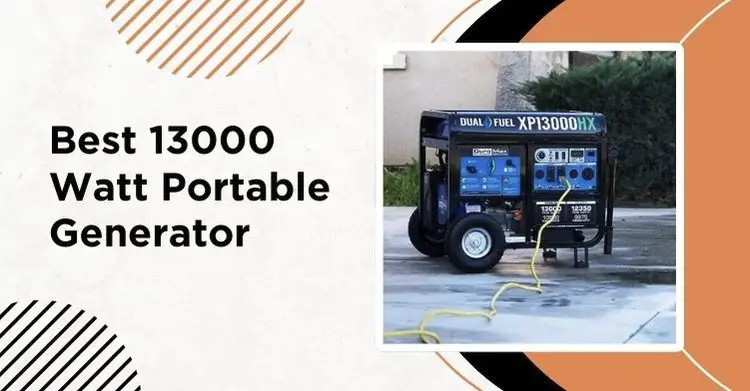
Best 13000 Watt Portable Generator of 2026: 7 Models Compared (Dual Fuel, Tri Fuel, CO Safety)
Updated: April 24, 2026
Quick answer: The best 13000 watt portable generator picks for 2026 are the DuroMax XP13000HX for premium dual-fuel home backup, the DuroMax XP13000HXT for whole-fuel flexibility (gas + propane + natural gas), and the Pulsar PG13000BRCO for the only generator in this class with Switch & Go technology (change fuel without shutting down). A 13,000W portable handles whole-home essentials plus central AC, electric dryer, or electric range with load management – but requires a 50A transfer switch or inlet to deliver its full output safely.
Honest market note (April 2026): The 13,000W portable category has more competition than most buying guides cover. The active brands we tracked for this guide are DuroMax (three variants), Pulsar (two variants), A-iPower, and Green-Power America. Champion and Predator also compete in or near this wattage class with models such as the Champion 201241 Tri-Fuel (13,500W running on gas) and Predator tri-fuel units; we focused this edition on the seven models above and will expand coverage to Champion/Predator in a follow-up. All specs below were verified against manufacturer product pages and owner’s manuals as of April 2026.
Quick decision: which 13,000W is right for you?
- Premium home backup with safety priority: DuroMax XP13000HX (5-year warranty, CO Alert)
- Budget-friendly dual-fuel: DuroMax XP13000EH (3-year warranty, same core specs)
- Want natural gas option for unlimited runtime: DuroMax XP13000HXT or Pulsar Tri-Fuel
- Hate shutting down to switch fuels: Pulsar PG13000BRCO (Switch & Go is the only one that allows on-the-fly switching)
- Sensitive electronics or high-altitude use: A-iPower SUA13000EFI (EFI + altitude sensing; THD listed as Standard)
- EPA-certified value pick: Green-Power America GN13000DEW
A 13,000W portable generator sits at the top of the portable home-backup category. It handles almost anything a typical U.S. home needs during an outage – refrigerator, freezer, well pump, sump pump, central AC (with soft-start or appropriate unit), electric dryer, electric range, lights, and entertainment – though not all simultaneously. This guide compares every current 13,000W model, covers the installation reality most guides skip (50A transfer switch, NEC code, electrician costs), and recommends specific picks by use case.
Best 13000 Watt Portable Generator: 7 Models Compared
| Model | Fuel | Gas Running | Propane Running | Tank (gas) | Weight | Warranty |
|---|---|---|---|---|---|---|
| DuroMax XP13000EH | Dual (gas/LP) | 10,500W | 9,975W | 8.3 gal | 234 lbs | 3 years |
| DuroMax XP13000HX | Dual (gas/LP) | 10,500W | 10,000W | 8.3 gal | 240-246 lbs | 5 years |
| DuroMax XP13000HXT | Tri (gas/LP/NG) | 10,500W | 9,500W | 8.3 gal | 240 lbs | 5 years |
| Pulsar PG13000BRCO | Dual (gas/LP) | 10,200W | 9,200W | 9.5 gal | 231 lbs | 3 years |
| Pulsar Tri-Fuel 13,000W | Tri (gas/LP/NG) | 10,200W | 9,200W | 8 gal | 216 lbs | 3 years |
| A-iPower SUA13000EFI | Gas (EFI) | 10,000W | N/A | 6.6-7 gal* | 218 lbs | 2 yr residential / 1 yr commercial |
| Green-Power GN13000DEW | Dual (gas/LP) | 10,500W | 9,550W | 6.6 gal | 204-214 lbs* | 2 years |
Specs verified against each manufacturer’s official product page and owner’s manual (April 2026). Gas running watts also expressed as rated/continuous watts on manufacturer spec sheets. Peak (starting) watts are 13,000W for all models on gasoline.
*A-iPower tank size: 7 gal marketing / 6.6 gal spec sheet. Green-Power weight: 204 lbs retailer / ~214 lbs owner’s manual. Verify against the current spec sheet for the exact revision you purchase.
Feature Matrix: Outlets, CO Safety, and Unique Tech
| Model | 120V Outlets | 240V Outlets | 50A RV | CO Safety | Unique Feature |
|---|---|---|---|---|---|
| XP13000EH | 2x 5-20R GFCI, 1x L5-30R | L14-30R | 14-50R | CO Sensor | Front-panel fuel selector |
| XP13000HX | 4x 5-20R GFCI | L14-30R | 14-50R | CO Alert (upgraded) | 500cc OHV, copper windings |
| XP13000HXT | 4x 5-20R GFCI, 1x L5-30R | L14-30R | 14-50R | CO Alert | Remote Start + Tri-Fuel + 5yr warranty + NG hose included |
| Pulsar PG13000BRCO | 4x 5-20R GFCI, 1x L5-30R | L14-30R | L14-50R | CO Sentry (auto-shutoff) | Switch & Go (fuel switch while running) |
| Pulsar Tri-Fuel | 4x 120V GFCI | L14-30R | L14-50R | CO Sentry (auto-shutoff) | Remote + electric + recoil start |
| A-iPower SUA13000EFI | 4x 5-20R | L14-30R | L14-50R | Low Oil Shutoff (no CO sensor) | EFI + altitude sensing + 69 dB (THD listed as “Standard”) |
| Green-Power GN13000DEW | 4x 5-20R | L14-30R | 50A RV (14-50R or TT-50A, see note) | Low Oil Shutoff + CO Seizer alarm | AVR + 3-in-1 digital display |
Key observations: Five of the seven models have dedicated automatic CO shutoff sensors (DuroMax XP13000EH with CO Sensor, HX/HXT with CO Alert, both Pulsar models with CO Sentry). Green-Power lists a CO Seizer alarm in the manual but not a CPSC-aligned active shutoff like DuroMax CO Alert or Pulsar CO Sentry. The Pulsar PG13000BRCO is the only portable in this class that lets you switch fuels without shutting down – a meaningful advantage during an active outage when you run out of one fuel. The A-iPower SUA13000EFI is the only gas-only model, and its EFI + altitude-sensing make it a strong pick for high-altitude use and EFI convenience. A-iPower markets it for sensitive electronics, but no specific THD percent is published – treat the electronics claim cautiously.
Best Premium Dual-Fuel: DuroMax XP13000HX
The DuroMax XP13000HX is our top pick for serious home backup. It offers 10,500W continuous on gas (13,000W peak) and 10,000W continuous on propane (12,500W peak) per the current DuroMax product page – slightly more propane headroom than the XP13000EH, but adds two meaningful upgrades: CO Alert (a CPSC-aligned automatic carbon monoxide shutoff, not just a passive sensor) and a 5-year warranty – the longest in this comparison.
What it runs: Whole-home essentials plus central AC (1.5-2 ton with soft-start, 2-3 ton without modification on many units), electric dryer, electric range (single burner), or well pump + water heater + fridge/freezer in realistic combinations.
Strengths: 500cc OHV engine with copper windings (not aluminum), all-metal frame, 50A 14-50R outlet for transfer switch or RV, electric start plus remote start key fob (per the current DuroMax product page), digital hour meter. Propane regulator and hose included out of the box.
Limitations: 240 lbs dry / ~246 lbs product is heavy – wheel kit and foldable handle help, but two people needed for tight spaces. Open-frame design around 74 dB – not quiet. No NG option (use XP13000HXT for tri-fuel).
Best for: Homeowners who want the most reliable portable backup in this class and value the longer warranty plus active CO safety.
Best Budget Dual-Fuel: DuroMax XP13000EH
The DuroMax XP13000EH delivers the same raw power as the HX at a lower price, with a 3-year warranty and a passive CO Sensor rather than the upgraded CO Alert shutoff.
Specs: 10,500W continuous on gas (13,000W peak), 9,975W continuous on propane (12,350W peak) per the current DuroMax product page. Same 8.3-gallon tank and 500cc engine as the HX.
Strengths: Same 500cc engine family as HX, similar all-metal construction, but fewer 120V 5-20R outlets than HX (2x vs 4x). 234 lbs (slightly lighter than HX). DuroMax front-panel fuel selector for quick gas/propane changes at shutdown.
Limitations: 3-year warranty vs 5-year on HX. CO Sensor instead of CO Alert. Otherwise mechanically identical.
Best for: Buyers who want DuroMax build quality without paying for the extended warranty and upgraded CO safety. If budget is tight, the EH is the same generator.
Best Tri-Fuel All-in-One: DuroMax XP13000HXT
The DuroMax XP13000HXT adds natural gas capability to the HX platform and bundles a 15-foot 3/4-inch NG hose, propane regulator, and a remote start key fob. For anyone with a natural gas line at the house or who wants the insurance of three fuel options, this is the DuroMax to pick.
What it runs: Same core capability as HX on gas/propane. On natural gas, output is approximately 11,000W peak / 8,500W running (per DuroMax current tri-fuel specs), and runtime is effectively unlimited as long as utility NG service remains available and the gas supply is properly sized for the unit.
Strengths: Tri-fuel (gas/LP/NG) with front-panel fuel selector. Remote start (not available on HX or EH) – start the generator from inside the house. 240 lbs, similar footprint to HX. CO Alert shutoff. All-metal frame.
Limitations: NG supply requires a qualified installer to tap your home gas line, and most utilities require notification. Running on NG lowers output to about 11,000W peak / 8,500W running (~15% below gas peak, ~19% below gas running). 240 lbs.
Best for: Homeowners with existing natural gas service who want the reliability of a portable combined with the unlimited runtime of a standby. Also strong for emergency prep if gasoline becomes hard to get.
Best Switch & Go Technology: Pulsar PG13000BRCO
The Pulsar PG13000BRCO is the only portable in this comparison (and one of very few portables at any wattage) that lets you switch between gasoline and propane while the generator is still running. Pulsar calls this “Switch & Go” – it uses a front-panel knob that blends fuels during a short transition rather than requiring a shutdown.
Why this matters: During a real outage, you do not want to shut down, refuel, wait, and restart – especially if your fridge is cycling, your well pump needs to refill a pressure tank, or a sump pump needs to keep running. Switch & Go lets you run gasoline until the can is empty, then flip to propane without losing power.
Specs: 13,000W peak / 10,200W running on gas, 11,500W / 9,200W on propane. Engine is a 500cc 17HP OHV. 9.5-gallon tank (the largest in this comparison), ~9.5 hours at 50% load. Multiple start options: remote, electric, and recoil. CO Sentry automatic shutoff. Four 120V GFCI outlets, one 120/240V L14-50R (50A) RV outlet, one L14-30R, one L5-30R.
Limitations: Not sold on Amazon at time of writing – buy direct from Pulsar, The Home Depot, Acme Tools, or Rural King. 3-year warranty. 231 lbs.
Best for: Anyone who has lived through a long outage and knows how disruptive a cold restart is. Best-in-class for uninterrupted operation.
Best Tri-Fuel Alternative: Pulsar Tri-Fuel 13,000W
The Pulsar Tri-Fuel 13,000W is the lighter, smaller-tank tri-fuel option. Compared to the DuroMax HXT it weighs 216 lbs vs 240 lbs, runs an 8-gallon tank vs 8.3, and uses slightly different ratings: 13,000W peak / 10,200W running on gas, 11,500W / 9,200W on propane, 10,500W / 8,160W on natural gas.
Strengths: Remote start, electric start, and recoil backup. Automatic voltage regulation. L14-50R outlet. Ships with NG hose, propane hose, and remote fob. Lighter than the DuroMax HXT.
Limitations: Smaller fuel tank means shorter runtime on gas (~7.5 hours at half load vs 8+ for DuroMax). 3-year warranty.
Best for: Tri-fuel buyers who prioritize lighter weight and do not need CO Alert shutoff.
Best for Sensitive Electronics and Altitude: A-iPower SUA13000EFI
The A-iPower SUA13000EFI is the only gas-only model in this comparison, and the only one with electronic fuel injection. Three things set it apart:
- EFI (electronic fuel injection): Like modern cars, this eliminates the carburetor. Easier cold starts, no carb cleaning, better fuel economy, lower emissions. EFI is rare on portable generators in 2026.
- Altitude sensing: Automatically adjusts fuel/air mixture as elevation changes. Critical if you live above 5,000 ft (generators without altitude compensation lose roughly 3.5% power per 1,000 ft).
- Output quality: A-iPower lists the output as “Standard THD” on the spec sheet without publishing a specific percent. EFI plus AVR typically gives more stable voltage/frequency than a carbureted open-frame unit, but the sensitive-electronics claim on A-iPower marketing is not backed by a published THD number. Treat it as a directional advantage, not a lab-verified spec.
Specs: 13,000W peak / 10,000W running on gas. 459cc single-cylinder OHV with EFI. Tank size is listed as 7 gallons on A-iPower marketing and 6.6 gallons / 25 L on the official spec sheet – assume 6.6 gal for conservative planning. Runtime up to 8.5 hours at 50% load. 69 dB – quieter than most DuroMax and Pulsar units in this class. 218 lbs net weight. 4x 5-20R, L14-30R, and a heavy-duty L14-50R outlet.
Limitations: Gas-only – no dual-fuel option at this wattage from A-iPower. No CO sensor or shutoff. Sold through A-iPower direct and specialty retailers; less common on big-box. Warranty: 2 years residential / 1 year commercial (shorter than DuroMax HX/HXT but standard for the EFI class).
Best for: High-altitude homes, anyone with sensitive electronics in a backup plan (HVAC control boards, modern appliance main boards), or workshops where clean power matters. Also the quietest option in this class.
Best EPA-Certified Value: Green-Power America GN13000DEW
The Green-Power America GN13000DEW is the lightest dual-fuel in this lineup at 204 lbs. It is EPA-compliant (relevant for CARB-restricted states and emission-sensitive jurisdictions) and keeps the footprint compact.
Specs: 13,000W peak / 10,500W running on gas. 11,750W / 9,550W on propane. 479cc OHV engine, 18 HP (per owner’s manual). 6.6-gallon tank. Owner’s manual lists runtime as 7.5 hours at 1/2 load on gas and 5.2 hours on propane; retailer listings sometimes show higher numbers. Built-in AVR and 3-in-1 digital display.
Strengths: EPA-certified. Among the lighter dual-fuel units in this class. Never-flat 10-inch wheels. Electric start with battery included. 50A RV outlet (retailer listings show either 14-50R or TT-50A depending on source – verify with the seller).
Limitations: Smaller tank (6.6 gal vs 8-9.5 gal competitors). Only 2-year warranty – the shortest in this comparison. Safety systems include low oil shutdown and a CO Seizer alarm documented in the owner’s manual, but this is not the same as the active CO shutoff on the DuroMax HX/HXT or Pulsar BRCO. Published weight varies from about 204 lbs on some retailer listings to ~214 lbs in the owner’s manual. Newer brand with fewer long-term reliability data points.
Best for: Buyers in states with strict emission rules, anyone who values the lighter weight, or budget-conscious shoppers who will pay attention to tank refills.
Fuel Economics: Real Cost Per Hour (April 2026)
A 13,000W generator at 50% load burns roughly 0.8-1.1 gallons of gasoline per hour or 1.7-2.0 gallons of propane per hour, depending on the specific unit. Calculated from manufacturer tank/runtime data: A-iPower ~0.78 GPH, Green-Power ~0.88, Pulsar BRCO ~1.0, DuroMax EH ~1.04, DuroMax HX/HXT ~0.98, Pulsar Tri-Fuel ~1.07. Translating typical ranges to dollars:
| Fuel | GPH @ 50% Load | Cost / Hour* | Cost / Day (8h runtime) | Cost / 3-day outage (24h runtime**) |
|---|---|---|---|---|
| Gasoline | 0.8-1.1 | $3.29-$4.53 | $26-$36 (8h/day) | $79-$109 (8h/day) / $237-$326 (continuous) |
| Propane | 1.7-2.0 | $4.54-$5.34 | $36-$43 (8h/day) | $109-$128 (8h/day) / $327-$384 (continuous) |
| Natural Gas | ~200-220 ft3/hr (full-load-near) | $2.79-$3.07 | $22-$25 (8h/day) | $67-$74 (8h/day) / $201-$221 (continuous) |
*Based on AAA national gasoline average $4.118/gal (April 14, 2026), EIA residential propane $2.657/gal (March 2026 – local refill typically higher), and EIA residential natural gas average around $13.94 per thousand cubic feet. NG volume figures (200-220 ft³/hr) tend toward the higher-load end for a 13kW portable; at 50% load actual use may be lower. **3-day outage figures show both typical intermittent runtime (8 hours per day) and continuous operation (24 hours per day) for comparison. Local prices vary substantially; recalculate with your pump and utility rates.
The natural gas advantage is decisive for long outages. At roughly 40-50% of gasoline cost per kWh produced and zero refueling (if your NG service remains active), tri-fuel with a home NG connection pays back the cost difference vs a dual-fuel-only unit within one extended outage. See our fuel shortage guide for multi-day planning.
Whole-Home Backup: Transfer Switch, NEC Code, and Electrician Costs
A 13,000W portable cannot safely feed your whole home through a regular 120V outlet. The only code-compliant ways to connect it are:
- Manual transfer switch: A dedicated switch that isolates selected circuits from the grid and connects them to the generator. Typical cost installed: $1,200-$2,000.
- Interlock kit: A mechanical interlock on the main panel that prevents simultaneous utility and generator connection. Requires a dedicated generator breaker in the panel. Typical cost installed: $800-$1,500.
- Generator inlet with external cord: A weather-rated inlet box (50A L14-50R for 13,000W) on the house exterior, wired through a transfer switch or interlock.
NEC code points (2023 NEC, still current 2026):
- NEC 702 covers optional standby systems including portable generators.
- The generator circuit must have overcurrent protection sized for the generator’s output.
- Interlock hardware must be listed for your specific panel manufacturer and model.
- A 50A 120/240V inlet is needed to avoid a 30A bottleneck. At 240V, a 30A inlet carries 7,200W; a 50A inlet carries 12,000W, which is enough for the generator’s continuous rated output. The generator’s 13,000W peak is a short-duration starting spec, not a continuous transfer-switch sizing target.
- Never backfeed through a standard 120V wall outlet. It is illegal in most U.S. jurisdictions and has killed utility linemen.
Cost ballpark for a complete whole-home install: $1,500-$3,500 including labor, transfer switch or interlock, inlet box, cord, and permit. Always use a licensed electrician. For smaller amp services, see our 200A service guide or 400A service guide.
What Can a 13,000W Portable Actually Power?
At roughly 10,000-10,500W continuous running watts (gas) and 13,000W peak for startup surges, you can run most of a typical U.S. home simultaneously – but not everything. The numbers below are example ranges – actual startup surge varies with compressor LRA, soft-start tuning, ambient temperature, and voltage sag. Always verify against your specific appliance nameplates.
| Scenario | Running Watts | Peak Surge | Fits 13,000W? |
|---|---|---|---|
| Whole-home essentials (fridge + freezer + well pump + sump + lights + TV) | ~3,500W | ~6,000W | Yes, huge headroom |
| Above + central AC (2-ton, no soft-start) | ~5,900W | ~12,000W | Yes, tight during compressor start |
| Above + central AC (3-ton with soft-start) | ~7,100W | ~10,500W | Yes, comfortable |
| Essentials + electric dryer (cycling) | ~8,900W | ~10,250W | Yes |
| Essentials + electric water heater + dryer simultaneously | ~13,400W | >13,000W | No – over capacity |
| Whole home + 4-ton central AC + electric range + dryer | ~17,000W | >20,000W | No – needs standby 20kW+ |
For smaller wattage class comparisons, see our 12,000W load guide or 7,500W guide.
Maintenance and Reliability
- First oil change: After 20-30 hours of break-in (all models). See our break-in guide.
- Subsequent oil changes: Every 50-100 hours. Most manufacturers specify SAE 10W-30 (5W-30 for cold weather).
- Air filter: Inspect every 25 hours, replace annually.
- Spark plug: Replace every 100 hours or annually.
- Fuel handling: Gasoline sitting more than 30 days needs a stabilizer (Sta-Bil or STA-BIL 360). Propane stores indefinitely.
- Cold storage: Drain the carburetor or run the generator dry before long storage. EFI models (A-iPower SUA13000EFI) are more forgiving but still benefit from stabilizer.
- Exercise: Run each model under load for at least 30 minutes monthly. This keeps seals wet, battery charged, and catches issues before an outage.
Warranty Comparison at a Glance
| Brand / Model | Warranty | Service Network Notes |
|---|---|---|
| DuroMax XP13000HX | 5 years limited | Authorized service centers nationwide; parts availability strong |
| DuroMax XP13000EH | 3 years limited | Same service network as HX |
| DuroMax XP13000HXT | 5 years limited | Same service network as HX; current DuroMax product page lists 5 yr for HXT |
| Pulsar PG13000BRCO / Tri-Fuel | 3 years limited | Authorized service centers; contact Pulsar support for warranty claims |
| A-iPower SUA13000EFI | 2 yr residential / 1 yr commercial | A-iPower dealer network; EFI parts through A-iPower direct |
| Green-Power America GN13000DEW | 2 years limited | Younger brand; warranty handled through Green-Power direct |
Always keep the receipt and register the generator with the manufacturer within 30 days of purchase.
Safety reminders:
- Carbon monoxide: Always outdoors, at least 20 feet from any building, with the exhaust pointed away from doors and windows. Never in a garage, carport, basement, or partially enclosed porch. Install battery-backup CO alarms on every level of your home (CPSC guidance).
- Backfeeding: Never plug a generator into a regular wall outlet to power your house. Use a transfer switch or interlock kit installed by a licensed electrician.
- Refueling: Shut down and let the engine cool before adding gasoline. Spilled fuel on hot exhaust causes fires.
- Propane tanks: Store outdoors only, upright. Never bring indoors even empty.
- Grounding: Most modern portable generators have a bonded neutral and do not require a separate ground rod for typical home use – but follow the manual for your specific model and any local requirements.
Frequently Asked Questions
What is the best 13,000-watt portable generator in 2026?
The DuroMax XP13000HX is our overall pick for premium home backup thanks to its 5-year warranty and CO Alert shutoff. The DuroMax XP13000HXT wins for tri-fuel flexibility (gas + propane + natural gas with remote start). The Pulsar PG13000BRCO is the only portable in this class with Switch & Go technology for on-the-fly fuel changes. The A-iPower SUA13000EFI is the best pick for sensitive electronics thanks to its EFI engine and altitude-sensing technology.
Can a 13,000-watt portable generator run a whole house?
Yes, for a typical U.S. home with load management. 13,000W / 10,500W continuous runs essentials plus a central AC (1.5-3 ton with soft-start or appropriate unit), or essentials plus electric dryer, or essentials plus water heater – but not all large loads simultaneously. A 50A transfer switch or interlock is required to deliver full output to house circuits.
Does Champion make a 13,000-watt portable generator?
Yes. Champion Power Equipment sells the 201241 Tri-Fuel portable rated at 13,500 running watts on gasoline (14,000-15,000W peak), which competes directly in this category. Champion also has a 201160 at 12,000W running. We focused this edition on the DuroMax, Pulsar, A-iPower, and Green-Power models; a follow-up will add Champion and Predator 13,000W options.
Is a 13,000W generator dual fuel or tri fuel better?
Tri-fuel is better if you have natural gas service at your home. NG provides effectively unlimited runtime if the utility stays up, and NG is typically 40-50% cheaper per kWh produced than gasoline. Dual-fuel (gas + propane) is sufficient for homes without NG service and slightly cheaper. If you already have dual-fuel and want Switch & Go technology, the Pulsar PG13000BRCO is unique in this class.
What transfer switch do I need for a 13,000W portable?
A 50A 120/240V transfer switch or interlock kit paired with a 14-50R inlet box. A 30A L14-30R setup carries only 7,200W, which bottlenecks a 13,000W generator’s continuous output. A 50A path carries 12,000W – enough for the generator’s continuous rating. Expect to pay $1,500-$3,500 for a licensed electrician to install the transfer switch, inlet, and wiring. The electrical work must comply with NEC 702 and local code.
How long will a 13,000W generator run on a full tank?
Typically 7.5-9.5 hours at 50% load on gasoline, depending on tank size. The Pulsar PG13000BRCO has the largest 9.5-gallon tank and runs up to 9.5 hours at half load. The Green-Power GN13000DEW has the smallest at 6.6 gallons and 8 hours. On propane, runtime depends on tank size – a 20-lb BBQ tank lasts roughly 4-5 hours at 50% load. Tri-fuel units on natural gas have unlimited runtime if the NG line stays pressurized.
Related Guides
- Best Dual Fuel Generators 2026
- What Will a 12,000W Generator Run? (Complete Load Guide)
- What Can a 6,500W Generator Run?
- What Size Generator for 200 Amp Service
- What Size Generator for 400 Amp Service
- Generator Size for a 5-Ton Central AC
- How to Install a Backup Generator
- How to Fix an Overloaded Generator
- How to Run a Generator During a Fuel Shortage
- Complete Power Outage Checklist
Last updated: April 16, 2026. Specs verified against each manufacturer’s official product page and owner’s manual.
Sources: DuroMax product pages (XP13000EH, XP13000HX, XP13000HXT), Pulsar Power Equipment (PG13000BRCO, Tri-Fuel 13,000W), A-iPower (SUA13000EFI), Green-Power America GN13000DEW (note: Green-Power documentation mixes GN13000DCS and GN13000DEW in the owner’s manual; parts lists and retailer pages contain variations – we cite both where they agree), AAA daily fuel gauge (April 14, 2026 national average), EIA residential heating fuels data (propane $2.657/gal March 2026), EIA natural gas residential pricing (~$13.94 per MCF), NEC 2023 Article 702, CPSC portable generator safety guidance.
Editorial note: This is a spec-verified buying guide, not a hands-on lab review. Always verify model-specific details (especially CO sensor presence, current warranty terms, and outlet mix) against the exact year/revision you purchase, and consult a licensed electrician before installing a transfer switch.
As an Amazon Associate I earn from qualifying purchases.