
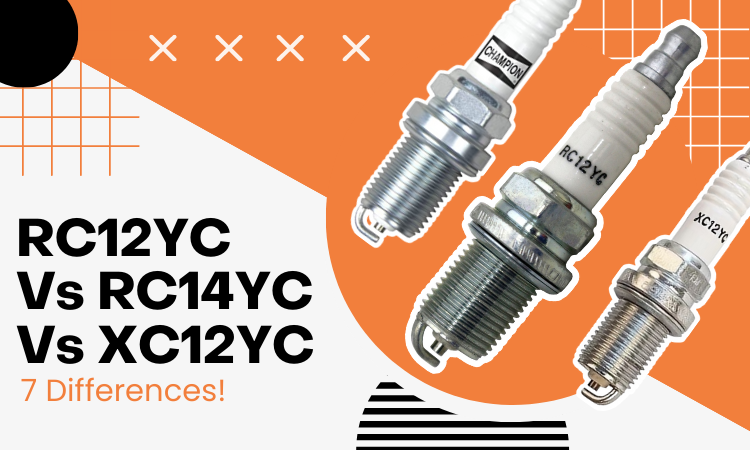
RC12YC Vs RC14YC Vs XC12YC: 7 Differences!
Updated: April 24, 2026
Quick answer (updated April 2026): RC12YC, RC14YC, and XC12YC are Champion 14mm x 1.25 plugs with 0.750″ reach and gasket seat, but they are not automatically interchangeable. RC14YC runs hotter than RC12YC and XC12YC (Champion heat range numbers get hotter as the number increases). RC12YC and RC14YC are resistor plugs; XC12YC uses Champion’s combined resistive/inductive suppression design. The plug’s factory gap is only a starting point. Many generators require the plug to be checked and re-gapped to the engine manual, commonly around 0.028–0.031″ or 0.030″. Always follow your generator or engine owner’s manual for plug type, gap, and torque.
RC12YC vs RC14YC: Which One Is Better for Generators?
For most current small generators and lawn-equipment engines, RC12YC is the more commonly specified plug. It is the colder heat range. It appears in many small-engine applications and generator manuals, but Champion, Briggs & Stratton, and Generac plug choices vary by exact model and year.
RC14YC is the hotter Champion heat range. It shows up in some older generator manuals (especially older Generac GP portables) and in applications that tend to foul a colder plug at light load. The hotter plug helps burn off deposits before they cause misfires.
If your engine manual lists RC12YC, a switch to RC14YC should only be done if the manufacturer explicitly allows a hotter plug. Do not assume the hotter plug is an upgrade. In the wrong engine, it can cause pre-ignition or detonation.
XC12YC vs RC12YC: When to Choose Which
Both share the same Champion C shell (14mm x 1.25, 0.750″ reach, gasket seat) and the same colder heat range of 12. The main practical differences are the suppression design (RC12YC uses SAC9 resistor construction, XC12YC uses Champion’s combined resistive/inductive suppression) and the factory-set gap. If your engine manual lists XC12YC specifically, use XC12YC. If it lists RC12YC, use RC12YC. Swapping between them should only be done if the manual or the manufacturer’s cross-reference explicitly allows it.
Generator owners often have to choose between several Champion spark plug variants, and the differences come down to heat range, gap, resistor type, and engine fit.
So, RC12YC Vs RC14YC Vs XC12YC – what are the differences?
The heat range of RC14YC is higher than the other two. RC12YC and RC14YC spark plugs are SAC9 resistor types while the XC12YC is a Resistive/Inductive type. The XC12YC has a narrower gap than the other two. All three typically carry a limited warranty against manufacturing defects. Retail pricing varies by region and retailer.
The detail behind each row is below.
RC12YC Vs RC14YC Vs XC12YC: Quick Comparison
Here is the side-by-side comparison.
| Feature | RC12YC | RC14YC | XC12YC |
| Heat range | 12 | 14 | 12 |
| Resistor type | SAC9 | SAC9 | Resistive/Inductive |
| Shell gap | .035″ (0.9mm) | .039″ (1.0mm) | ~0.030-0.031″ (0.75-0.8mm) |
| Warranty | Limited warranty against defects | Limited warranty against defects | Limited warranty against defects |
| Typical service life | ~100 engine hours / annually | ~100 engine hours / annually | Per manufacturer recommendation |
| Price tier | Mid | Budget | Budget |
All three plugs use Champion’s C shell, which means they share the following physical dimensions:
| Spec | Value |
|---|---|
| Thread size | 14 mm x 1.25 |
| Reach | 0.750″ (19 mm) |
| Seat type | Gasket |
| Hex size | 5/8″ (16 mm) |
| Terminal | Standard SAE threaded |
Because the shell dimensions are identical, all three plugs will physically thread into the same cylinder head. Differences that matter for the engine are heat range, gap, and resistor/suppression design, not physical fit.
RC12YC Vs RC14YC Vs XC12YC: In-Depth Comparison
Each section below explains one row of the comparison table.
Heat Range:
RC12YC, RC14YC, and XC12YC have different heat ranges of 12, 14, and 12 respectively. The heat range describes how quickly the spark plug transfers heat from the firing tip into the cylinder head. On Champion plugs, higher numbers run hotter and lower numbers run colder, so RC14YC runs hotter than RC12YC and XC12YC.
RC12YC and XC12YC share the same colder heat range (12). They are typical for smaller and lower-load generator engines that do not need the extra tip heat to stay self-cleaning.
RC14YC has the hotter Champion heat range of the three. It is usually listed for engines that need a slightly hotter plug to avoid fouling under light loads or in older air-cooled designs.
Resistor Type:
The RC12YC and RC14YC have SAC9 resistor-type spark plugs while the XC12YC is a regular Resistive/Inductive spark plug.
SAC9 is Champion’s designation for their standard resistor construction on the R-series plugs. Like other resistor plugs, they are designed to reduce radio frequency interference (RFI) and ignition noise.
The XC12YC uses Champion’s combined resistive/inductive suppression design (the X prefix). This is a different suppression approach than the SAC9 resistor, not a missing one.
Shell Gap:
RC12YC, RC14YC, and XC12YC are commonly listed around 0.035″, 0.039″, and ~0.030-0.031″ respectively, but the engine-manual gap overrides the plug’s factory gap. Many small-engine and generator manuals specify 0.028-0.031″ or 0.030″ regardless of which of these three plugs is used. The gap is the distance between the center electrode and the side electrode.
The gap is one of the factors that decide the compatibility of the spark plug with your generator. If you install a spark plug with a too-small gap, there will be a lack of room for the air-fuel mixture.
On the other hand, if the gap is too wide, your engine will face weaker sparks.
It is very important to choose a spark plug that matches your generator engine. A wrong plug is also a common cause of a generator that keeps shutting off or refuses to stay running. Misfiring can also result from a wrong heat range or gap. While you are troubleshooting your Duromax xp12000eh or other generators for misfiring problems, keep the spark plug in mind.
Swappable Brands:
All three plugs have documented cross-references in aftermarket and OEM catalogs. Exact equivalents depend on the engine, and a cross-reference by model number alone does not guarantee that the alternate plug is the right gap, heat range, and seat for your application. Always confirm against your engine’s current owner’s manual or Champion’s official cross-reference lookup before substituting.
Warranty:
Champion spark plugs typically carry a limited warranty against manufacturing defects. Exact terms depend on retailer and region, so check the warranty listed with the plug you purchase.
However, Champions recommends replacing the spark plugs after every interval mentioned in your generator’s owner manual.
Longevity:
The 20,000-mile figure often quoted for RC12YC and RC14YC applies to automotive use. In small-engine and generator applications, Champion recommends replacing the spark plug roughly every 100 engine hours or once per year, whichever comes first. All three plugs carry a limited warranty against manufacturing defects. Regardless of warranty, the plug must be replaced at the interval listed in your engine manual.
See the owner’s manual of your generator for the recommended spark plug replacement interval and replace it accordingly.
Availability and Value:
All three plugs are widely stocked at hardware stores and online. Multi-packs (4-pack, 8-pack) usually offer better value per plug than singles, and they are worth keeping on hand since most generators need a spark plug change every 100 engine hours or once a year.
RC12YC Vs RC14YC Vs XC12YC: Which One to Choose?
When choosing a spark plug, the first thing you must consider is its compatibility with your generator. Check the generator’s owner manual for recommended heat range and gap for spark plugs. And then decide which spark plug is suitable for your generator.
RC14YC may be specified in engines that tend to foul a colder plug under light load. It should not be chosen just because a generator is larger – heat range does not directly scale with generator size.
RC12YC/RC14YC and XC12YC use different suppression designs. Choose based on what your engine manual specifies, not based on noise expectations.
XC12YC uses Champion’s combined resistive/inductive suppression design. If your engine manual lists XC12YC as the approved plug, use XC12YC; otherwise, stay with the plug listed in the manual.
Which Champion Plug Is Specified for Your Generator?
Plug choice and gap vary by model and year. Use the table below only as a starting point and always verify against your specific engine’s owner’s manual.
| Generator Brand / Engine | Commonly Listed Plug (verify by model) | Typical Engine-Manual Gap |
|---|---|---|
| Champion portable generators | Often Torch/NHSP F6RTC or NGK BPR6ES equivalent; plug type varies by model | Commonly 0.028–0.031″ |
| Generac GP series (older portable) | Some manuals specify RC14YC or equivalent | 0.030″ per manual |
| Briggs & Stratton OHV (some applications) | Some applications list a replacement for RC12YC; others use RC14YC for hotter spark | 0.030″ per manual |
| Kohler Courage / Command (select models) | RC12YC is commonly listed; some charts show RC14YC | 0.030–0.040″ depending on model |
| Predator open-frame (many models) | Torch/NHSP F7TC (not Champion); verify by model | 0.028–0.031″ |
If your engine shipped with a plug different from the table, the manual wins. Engines updated mid-production sometimes moved between plug models.
Cross-References to Other Brands
Possible aftermarket cross-references by application. None of these substitutions should be relied on without checking dimensions and your current engine manual. Iridium and platinum fine-tip plugs should not be re-gapped with a feeler gauge. Check the manufacturer’s instruction for that specific plug.
| Champion | Common NGK cross-reference (verify) | Notes |
|---|---|---|
| RC12YC | NGK BKR5E or similar (application-dependent) | Resistor plug; confirm gap and reach per manual |
| RC14YC | NGK equivalent is application-dependent | Runs hotter than RC12YC; older Generac portable applications |
| XC12YC | Do not substitute without confirming dimensions | Uses Champion’s combined resistive/inductive design; iridium alternates should not be re-gapped |
Exact equivalents vary by engine and reach/seat requirements. Use the NGK, Denso, or Autolite official cross-reference tool before substituting.
How to Check and Adjust the Spark Plug Gap
A wrong gap is one of the most common causes of hard starting, misfires, surging, and rough running on small engines. Factory-gapped plugs can still shift during shipping, so verify the gap before installing.
- Look up the correct gap in your engine’s owner’s manual (most current generators use 0.030″; some older engines and inverter models use 0.028″ or 0.031″).
- Slide the correct feeler gauge blade between the center and side electrodes. It should pass with light drag.
- If the gap is too wide, gently tap the side electrode closed against a clean surface. If too narrow, slide the gauge in and carefully pry it open.
- Never pry against the center electrode or the ceramic insulator. Both break easily.
- Re-check the gap after adjusting and before installing.
Install the plug hand-tight first, then torque it to spec per your engine manual. For a new gasket-seat plug, Champion’s own listings typically call for around 18–22 ft-lb in an aluminum cylinder head and 26–30 ft-lb in a cast-iron head. Many small-engine manuals instead specify finger-tight to gasket contact, then 1/2 to 2/3 of a turn. Do not over-tighten a plug in an aluminum cylinder head. It is easy to strip the threads.
Where to Buy RC12YC Spark Plugs
Need to replace your spark plugs? The Champion RC12YC 4-Pack is a commonly stocked Champion plug that fits many small-engine applications. Check your generator manual before ordering to confirm the plug your engine specifies. Having a spare set on hand is always smart for regular maintenance.
To check and adjust the spark plug gap, a GEARWRENCH Feeler Gauge Set makes the job easy. The correct gap for most generators is 0.028-0.031 inches.
Conclusion
Choosing between RC12YC, RC14YC, and XC12YC comes down to three things: what your engine manual recommends, the correct gap for your engine, and your climate or load profile. When in doubt, stick with the plug listed in the manual and replace at the recommended interval to avoid starting problems.
Frequently Asked Questions (FAQs):
Can You Use XC12YC Instead of RC12YC?
The RC12YC and XC12YC use the same Champion C shell: 14mm x 1.25 thread, 0.750″ reach, gasket seat. They will physically fit in the same cylinder head. However, they differ in resistor design and factory-set gap. The safest answer is to use the spark plug listed in your engine owner’s manual and only substitute if the manual or the manufacturer’s current cross-reference explicitly allows it.
What Is The Champion XC12YC Equivalent To?
From the champion brand, the XC12YC is equivalent to XC12YC/T04 and 982. From other brands, this spark plug is equivalent to Accel 786, Autolite 3924, Brisk 1326, and Beru 14F-8LUR. There are some other swappable models including, Mitsubishi MS851737, Kohler 2413214, and Denso K16PR-U.
What Spark Plug Is The Same As RC12YC?
Brisk D17Y, Denso 3191, Denso K16GPR-U11, ACDelco 41602, and ACDelco 5 are similar to the RC12YC spark plug. From the Champion brand, the RC12YC is similar to 71GS, C12YCC, OE137, RC12YC/T06, RC12YCC4 and SE12RCY.
Can RC12YC replace RC14YC?
The RC12YC and RC14YC share the same Champion C shell (14mm x 1.25 thread, 0.750″ reach, gasket seat), so they will physically fit in the same cylinder head. However, they differ in heat range: RC14YC runs hotter. If your engine manual specifies RC14YC, substituting a colder RC12YC may cause fouling under light loads. Only swap if the engine manufacturer or Champion’s current cross-reference explicitly allows it.
Is RC14YC hotter than RC12YC?
Yes. On Champion plugs, a higher heat range number means a hotter plug. RC14YC has a heat range of 14; RC12YC has a heat range of 12. The hotter plug transfers less heat away from the tip, which can help prevent fouling under light loads but also raises the risk of pre-ignition in the wrong engine.
What is the correct gap for a Champion RC12YC?
Champion lists a factory-set gap around 0.035″ for the RC12YC, but the plug’s factory gap is not the same as your engine’s required gap. Many small engines and generators specify 0.028-0.031″ or 0.030″ regardless of what the plug ships with. Always set the gap to the value listed in your engine owner’s manual, not the factory pre-gap on the plug.
What is the NGK equivalent of the Champion RC12YC?
NGK’s cross-reference for Champion RC12YC commonly returns matches such as BKR5E and close variants, depending on the application. Because the correct NGK equivalent depends on gap, reach, and heat range for your specific engine, always verify against NGK’s current cross-reference tool or your engine manual before installing.
How often should you replace a Champion spark plug on a generator?
Most small-engine manufacturers recommend inspecting, cleaning, and re-gapping the spark plug about every 100 engine hours or once per year, whichever comes first. Replace the plug according to the interval in your engine manual, or earlier if the electrode is heavily worn, cracked, fouled, or oily.
What are the signs of a bad spark plug on a generator?
Typical signs are hard starting or failure to keep running, rough running, surging, loss of power under load, and visible fouling on the electrode (black carbon indicates rich running, oily indicates oil blow-by, white indicates overheating or lean running). Replace any plug with a cracked insulator or heavily worn electrodes.
As an Amazon Associate I earn from qualifying purchases.