
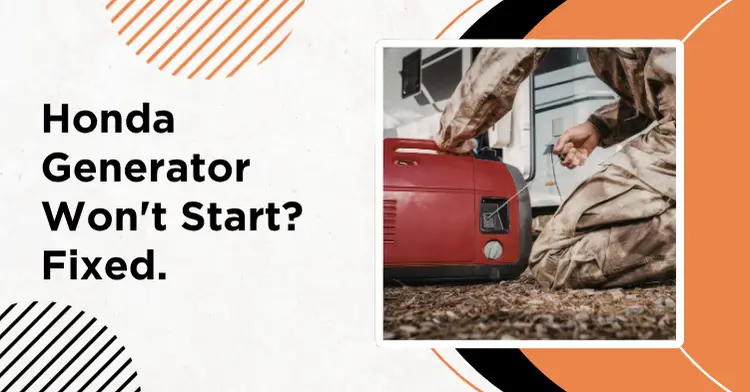
Honda Generator Won’t Start? 12 Manual-Verified Fixes for EU2200i, EU3000iS, EU7000iS & More
Updated: April 21, 2026
Quick answer: The three most common reasons a Honda generator won’t start are stale fuel (which Honda says can deteriorate in as little as 30 days), a clogged carburetor from fuel residue, and a fouled spark plug. Before reading further, check these five things: fuel valve is ON, choke is in the correct position, oil level is between the marks on the dipstick, fuel is fresh, and the engine switch is ON. If all five check out and the generator still won’t start, this guide covers 12 causes with model-specific fixes for the EU2200i, EU3000iS, EU7000iS, and selected open-frame Honda models.
Specs and intervals verified against Honda owner’s manuals (EU2200i, EU3000iS, EU7000iS, EB2800i) and Honda Power Equipment support pages, checked April 20, 2026.
Honda generators are known for reliability, but they are not immune to starting problems. Most no-start issues come down to fuel quality, basic maintenance, or a component that wears out over time. Many simple fixes (spark plug, carb cleaner, fresh fuel) cost under $20 in parts; more involved fixes like a carburetor rebuild or ignition coil replacement cost significantly more.
If your honda generator won’t start, this guide covers every cause in order from most common to least common, with specs and approximate repair costs for each Honda model.
Quick Troubleshooting Checklist
Run through these five checks before doing anything else. These cover the most common causes:
- Fuel valve: Is it set to ON? (Not OFF or RESERVE)
- Choke: Is it ON/CLOSED for a cold start? (OFF/OPEN if the engine is warm)
- Oil level: Is it between the upper and lower marks on the dipstick? Low oil triggers Oil Alert; Honda warns that overfilling can transfer excess oil to the air cleaner housing and filter.
- Fuel freshness: Is the gasoline fresh? Honda says gasoline can deteriorate in as little as 30 days. Does it smell normal, not varnish-like?
- Engine switch: Is it set to ON? (On inverter models, the Eco Throttle switch position matters too)
If all five check out and the generator still won’t start, work through the causes below.
Cause 1: Stale or Contaminated Fuel
Stale fuel is the most common reason Honda generators fail to start after storage. Honda says gasoline can deteriorate and oxidize in as little as 30 days, with warmer temperatures, higher humidity, and ethanol content accelerating the process. The lighter compounds evaporate first, leaving behind a thicker residue that clogs fuel passages. Old gasoline is one of the most common causes of hard starting on Honda generators. Honda notes that gasoline can begin to degrade in as little as 30 days, leaving gum deposits that clog the fuel system.
Symptoms: Engine cranks but won’t fire, or fires briefly and dies. Fuel may smell like varnish instead of gasoline.
Fix:
- Drain the old fuel from the tank and carburetor bowl (use the carburetor drain screw at the bottom of the carb)
- Fill with fresh gasoline
- Add STA-BIL fuel stabilizer to prevent future degradation
- Try starting again
Prevention: For storage beyond about 30 days, follow your model’s storage schedule. Use fresh stabilized fuel for short storage; for longer storage, drain the carburetor (and, where specified by the manual, the tank). The EU2200i has a “Fuel Off” function that runs the engine until most of the fuel in the carburetor is consumed – use that before longer storage. Check your owner’s manual for the exact procedure for your model.
Our old gas troubleshooting guide covers fuel recovery in detail.
Cause 2: Clogged Carburetor
If stale fuel sat in the carburetor for weeks or months, the residue may have hardened into a varnish that blocks the jets and passages. This is the most common cause of a Honda generator that cranks but won’t start even with fresh fuel.
Honda notes that old gasoline leaves gum deposits and can clog the carburetor fuel passages. In some cases, the carburetor is too far gone for cleaning alone and needs full replacement.
Symptoms: Engine cranks, may sputter briefly, but won’t run. Fresh fuel does not fix the problem.
Fix (try in order):
- Spray carburetor cleaner into the air intake while cranking. If the engine briefly runs on the cleaner spray, the carburetor is confirmed clogged. Use carburetor cleaner spray directly on the carburetor jets and passages.
- Remove and clean the carburetor. Disassemble, soak jets in carb cleaner, clear all passages with compressed air. Reinstall and test.
- Replace the carburetor if cleaning does not work. For the EU2200i, OEM carburetor assemblies typically run about $95-$140 from authorized parts dealers; aftermarket alternatives can be lower. On smaller Honda generators, replacing is often more cost-effective than repeated cleaning attempts – but verify part number for your exact serial range.
Cause 3: Fouled or Worn Spark Plug
A spark plug coated in carbon, oil, or fuel residue cannot produce a reliable spark. Spark plug issues are another common cause, especially on generators that have been stored for months.
Correct spark plug by model:
| Honda Model | Spark Plug | Gap |
|---|---|---|
| EU2200i / EU2200i Companion | NGK CR5HSB | 0.024-0.028 in (0.6-0.7 mm) |
| EU3000iS | NGK BPR6ES | 0.028-0.031 in (0.7-0.8 mm) |
| EU7000iS | NGK BPR6ES | 0.028-0.031 in (0.7-0.8 mm) |
| EB2800i | NGK BPR6ES | 0.028-0.031 in (0.7-0.8 mm) |
| EB5000X | NGK BPR5ES | 0.028-0.031 in (0.7-0.8 mm) |
| EG4000 / EG5000 | NGK BPR5ES | 0.028-0.031 in (0.7-0.8 mm) |
Always verify against your specific owner’s manual. Part numbers can vary by production year.
Fix: Remove the spark plug, inspect it. If the electrode is black, wet, or corroded, clean it with a wire brush or replace it. Check the gap with a feeler gauge and adjust if needed. A new spark plug costs $3-8 and takes 5 minutes to replace.
Cause 4: Low Oil Level (Oil Alert System)
Honda generators have an Oil Alert system that prevents the engine from starting when the oil level is too low. This protects the engine from damage, but it also means the generator won’t start if oil drops below the sensor threshold.
On the EU2200i, low oil triggers Oil Alert and prevents starting. Honda also warns that overfilling can transfer excess oil to the air cleaner housing and air filter, which can cause running problems and dirty the filter; treat overfill as a problem to correct, even if it does not always prevent starting.
Fix: Check the dipstick. Oil should be between the upper and lower marks. If low, add the correct type. If overfilled, drain to the correct level.
| Honda Model | Oil Type | Oil Capacity |
|---|---|---|
| EU2200i | SAE 10W-30 (API SJ+); see manual temperature chart | 14 oz (0.44 L) |
| EU3000iS | SAE 10W-30 (API SJ+); see manual temperature chart | 18 oz (0.55 L) |
| EU7000iS | SAE 10W-30 (API SJ+); see manual temperature chart | 1.2 US qt (1.1 L) |
| EB2800i | SAE 10W-30 (API SJ+); see manual temperature chart | 19.6 oz (0.58 L; maximum capacity – refill amount after oil change is slightly less) |
Honda recommends SAE 10W-30 for general use, or an equivalent oil meeting API Service Classification SJ or later. Other viscosities shown in your model’s temperature chart may be used when the average local temperature is within the range noted for that viscosity. Check your owner’s manual for the chart specific to your model.
Cause 5: Fuel Valve Closed
The simplest fix on this list. The fuel valve (petcock) must be in the ON position for fuel to reach the carburetor. If it was turned to OFF for storage (which is correct practice), it needs to be reopened before starting.
Fix: Turn the fuel valve to ON. Wait 30 seconds for fuel to fill the carburetor bowl, then try starting.
Cause 6: Choke in Wrong Position
A cold Honda engine needs the choke ON (closed) to enrich the fuel mixture for starting. Once the engine warms up (1-2 minutes), move the choke to OFF (open). Starting a warm engine with the choke on floods it with too much fuel.
If the generator only runs with the choke on and dies when you move it to the run position, the carburetor is likely clogged or the idle jet is blocked. This is a carburetor problem, not a choke problem.
Our Honda choke-on troubleshooting guide covers this issue step by step.
Cause 7: Clogged Air Filter
A dirty air filter restricts airflow to the engine, preventing the correct fuel-air mixture for combustion. In dusty conditions, the filter can clog in a single day of use.
Fix: Remove the air filter cover, inspect the filter. The EU2200i has a main filter and an outer filter. The foam elements can be washed with warm soapy water, dried, and lightly oiled before reinstalling. The EU3000iS has both a foam air filter (washable) and a paper air filter (replace when dirty). Replace paper elements rather than trying to blow them clean with compressed air, which can tear the filter material.
Cause 8: Dead Battery (Electric Start Models)
The EU3000iS and EU7000iS have electric start. If the battery is dead or weak, the starter motor cannot crank the engine fast enough to start. These batteries self-discharge over months of storage.
Fix: Charge the battery with a battery tender or trickle charger. If the battery won’t hold a charge, replace it. Both the EU3000iS and EU7000iS have a recoil (pull-start) backup per Honda; use that to start the generator while the battery charges. For other Honda electric-start models, check your owner’s manual for whether a recoil backup is fitted.
Cause 9: Fuel Cap Vacuum Lock
The fuel cap has a small vent that allows air into the tank as fuel is consumed. If this vent gets clogged (dirt, debris, or a damaged gasket), a vacuum builds in the tank and fuel stops flowing to the carburetor.
Symptoms: Generator starts, runs for a few minutes, then dies. Loosening the fuel cap fixes the problem temporarily.
Fix: Clean the vent hole in the fuel cap. If the cap is damaged, replace it. To test: loosen the fuel cap slightly and try starting. If it starts with a loose cap but not with a tight cap, the vent is the problem.
Cause 10: Faulty Ignition Coil
The ignition coil generates the high voltage that fires the spark plug. If it fails, there is no spark and the engine cannot start. This is less common than fuel or spark plug issues but does occur, especially on generators with many hours of use.
Symptoms: Engine cranks normally, has fuel, but produces no spark at the plug.
Fix: Test with an inline spark tester (available at auto parts stores). If there is no spark, the ignition coil likely needs replacement. This is typically a professional repair.
Safety warning: Never test for spark by holding the spark plug against the engine block while cranking. Use a proper inline spark tester. The high voltage from the ignition coil can cause injury.
Cause 11: Blocked Fuel Line or Fuel Filter
Debris, rust from an old fuel tank, or degraded fuel residue can block the fuel line between the tank and carburetor. Some Honda models have an inline fuel filter that can also clog.
Fix: Disconnect the fuel line at the carburetor (with a container underneath to catch fuel). Turn the fuel valve ON briefly. If fuel flows freely, the line is clear. If not, clear or replace the fuel line. Replace the inline filter if present.
Cause 12: Eco Throttle Switch Position
On Honda EU3000iS and EU7000iS (per Honda manuals), start the generator, let it warm up for 2-3 minutes, then switch Eco Throttle to ON for fuel savings. On smaller EU models, follow the specific starting procedure in your owner’s manual. On the EU2200i, Honda says to start with Eco Throttle OFF; otherwise warm-up may take longer. Turn Eco Throttle ON after the engine has warmed up (typically 2–3 minutes).
Honda Generator Maintenance Schedule
Most starting problems are preventable with regular maintenance. Intervals vary significantly by Honda model. The schedule below is representative for the EU2200i and EU3000iS. Open-frame models like the EB2800i have earlier first-service intervals – for example, EB2800i first oil change is at 5 hours/1 month, first air filter clean at 25 hours/3 months, spark plug replacement at 250 hours/2 years. Always check your specific owner’s manual.
| Task | Frequency | Notes |
|---|---|---|
| Check oil level | Before every use | Do not overfill |
| Change oil | First at 20 hours, then every 100 hours or annually (EU2200i/EU3000iS) | SAE 10W-30 (API SJ+); see manual temperature chart. Open-frame models (EB2800i) have earlier first-service intervals. |
| Clean/replace air filter | Every 50 hours (dusty: more often) | Foam: wash and oil. Paper: replace. |
| Check/adjust spark plug | Every 100 hours or annually | Check/adjust gap every 100 hours. Replace interval varies by model: EU2200i every year/200 hours, EU3000iS every year/300 hours, EB2800i every 2 years/250 hours |
| Stabilize/drain fuel | Storage beyond ~30 days (per Honda) | Use fresh stabilized fuel; for longer storage, drain carburetor per model procedure |
| Run generator monthly (best-practice) | 15-20 minutes under load | Not a Honda manual interval; general maintenance tip to prevent carburetor gumming |
For a complete break-in guide for new Honda generators, see our generator break-in guide.
Safety reminders:
- Carbon monoxide (CPSC): Run the generator outside only, at least 20 feet from the house, not on a porch or in a carport. Direct exhaust away from your home and other building entrances, and close windows or seal vents near the generator or in the exhaust path. Never in a garage, basement, or enclosed space, even with doors open. CO is odorless and can kill in minutes. Install CO alarms on each level of the home and outside separate sleeping areas; interconnected alarms are best.
- Backfeed: Never plug the generator into a wall outlet. Backfeeding is extremely dangerous and not code-compliant unless done through a proper transfer switch or approved interlock installed per code; it can electrocute utility lineworkers and neighbors.
- Refueling: Shut down and let the generator cool before adding fuel. Spilling gasoline on a hot engine or exhaust can cause a fire.
CO-MINDER (Newer EU Models)
Honda rolled out CO-MINDER carbon monoxide shutoff broadly starting in 2020. Current EU2200i, EU3000iS, EU7000iS and other EU-series models include this system. If the generator starts but stops quickly (especially in a partially enclosed space, a shed, or near an open wall), and the CO-MINDER warning light is on, the system has detected elevated CO and shut the engine down.
- Move the generator to a more open outdoor location, at least 20 feet from the house, exhaust pointed away.
- Wait for the warning light to clear before restarting. On some models (EU2200i), restart is only possible after the CO alarm indicator turns off on its own. On others (EU7000iS), press the CO-MINDER reset button after relocating the generator. Check your model’s manual for the exact procedure.
- Do not disable CO-MINDER or try to bypass the sensor. It is a life-safety system.
EU2200i Vacuum Fuel Pump Note
The EU2200i uses a vacuum-operated fuel pump. After running the carburetor completely dry (Fuel Off storage), the pump may need several extra pulls of the recoil starter – or several seconds of cranking – to draw fuel back up to the carburetor and prime it. If the engine fires and dies repeatedly after storage, keep cranking a few more cycles before concluding something is wrong.
When to Call a Professional
Some issues are beyond DIY repair:
- Ignition coil failure: Requires specialized testing and replacement
- CO-MINDER sensor diagnostics: If the generator shuts down on CO-MINDER even in clean open-air conditions, the sensor or circuit needs professional testing – never bypass the system
- Compression or valve-clearance issues: Low compression or out-of-spec valve lash requires a service manual procedure
- Internal engine damage: Scored cylinder, damaged valves, or crankshaft issues
- Repeated carburetor clogging after proper cleaning: May indicate a fuel tank or fuel system contamination issue
- Electric start system failure (starter motor, solenoid, or wiring): Electrical diagnosis is needed
Honda offers authorized service through their dealer network. For Honda Power Equipment customer relations call 770-497-6400, or find a dealer at powerequipment.honda.com. (The 888-438-8837 line is Sheffield Financial for financing assistance, not general product support.)
Frequently Asked Questions
Why won’t my Honda EU2200i start?
The most common causes for an EU2200i that won’t start are stale fuel in the carburetor, a clogged carburetor (the EU2200i’s small float bowl makes it prone to fuel residue buildup), and a fouled NGK CR5HSB spark plug. Check the oil level carefully – Honda warns that overfilling can transfer excess oil to the air cleaner housing and filter, which can cause running problems. Start troubleshooting with fresh fuel, then check the spark plug, then inspect the carburetor.
What spark plug does a Honda EU2200i use?
The Honda EU2200i uses an NGK CR5HSB spark plug with a gap of 0.024-0.028 inches (0.6-0.7 mm). The EU3000iS and EU7000iS use an NGK BPR6ES with a gap of 0.028-0.031 inches (0.7-0.8 mm). Always verify against your owner’s manual since part numbers can vary by production year.
How often should I change the oil in my Honda generator?
For the EU2200i/EU3000iS, Honda recommends the first oil change at 20 hours, then every 100 hours or once per year. Open-frame models like the EB2800i have earlier first-service intervals (first oil change at 5 hours/1 month). Honda recommends SAE 10W-30 (API SJ+) for general use, with other viscosities from the temperature chart if the average local temperature warrants it. Do not overfill. The EU2200i holds about 14 oz (0.44 L).
How much does it cost to fix a Honda generator that won’t start?
Simple fixes (spark plug $3-8, carb cleaner $4-8, fresh fuel with stabilizer $15-20) stay under $20. OEM EU2200i carburetor assemblies typically run about $95-$140; aftermarket options can be lower. Professional diagnostic visits often start at $45-$100, with labor commonly $75-$125 per hour, so total repair cost depends heavily on the fault. For engines with internal damage, repair costs can exceed the value of the generator.
Why does my Honda generator only run with the choke on?
If the generator runs with the choke on but dies when you move the choke to the run position, the carburetor is almost certainly clogged. The choke enriches the fuel mixture enough to overcome a partially blocked jet. Clean or replace the carburetor to fix this permanently.
Can I use non-Honda oil in my Honda generator?
Yes, as long as the oil meets API Service Classification SJ or later and is an appropriate viscosity for your average operating temperature (Honda recommends SAE 10W-30 for general use; see the temperature chart in your manual for your climate). Honda-branded oil is not required. Any quality detergent oil from a reputable brand (Mobil 1, Valvoline, Pennzoil, Castrol) works. Avoid non-detergent oil and oil additives.
When a Honda generator won’t start, the cause is almost always fuel, spark plug, or oil related. Most starting problems trace back to stale fuel that was left in the carburetor during storage. The simplest prevention is to follow Honda’s storage schedule for your model: for storage beyond about 30 days, use fresh stabilized fuel, and for longer storage drain the carburetor and follow the manual’s full storage procedure.
Related guides:
- Honda Generator Only Runs With Choke On
- Generator Starts Then Dies: 10 Causes and Fixes
- Generator Surging? Why It Revs Up and Down
- Generator Keeps Shutting Off? 13 Causes
- Generator Runs But No Power Output
- How to Fix a Generator With Old Gas
- How to Break In a Generator
As an Amazon Associate I earn from qualifying purchases.
Last updated: April 20, 2026.