
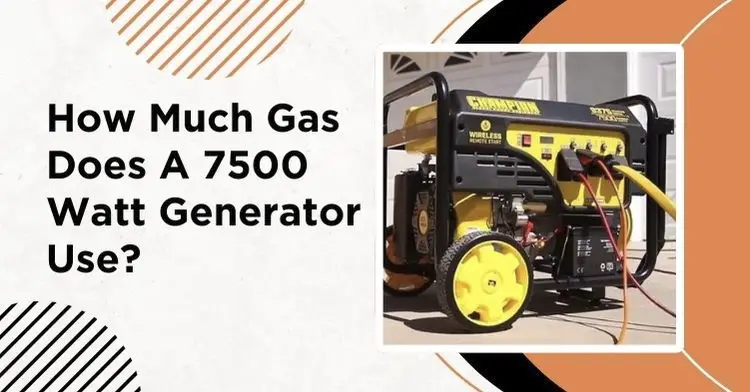
How Much Gas Does a 7,500-Watt Generator Use? Real GPH by Load + Can It Run Central AC?
Updated: April 14, 2026
Quick answer: How much gas does a 7500 watt generator use? About 0.60-0.80 gallons per hour at 50% load. With a typical 6.6-8 gallon tank, that gives you 10-12 hours of runtime. At full load, consumption rises to roughly 1.2-1.5 GPH. A 7,500W unit hits the sweet spot for running a 1-1.5 ton central AC (with a soft-start kit) plus essential circuits during summer outages.
The summer outage question: A 7,500W generator is the smallest portable class that can realistically back up a 1-1.5 ton central AC. A soft-start kit is often needed (especially for 1.5 ton) because the raw ~5,400W startup surge can otherwise eat nearly all your capacity. With a soft-start installed, surge drops by up to 75% and you can run AC + fridge + essentials on an 8-gallon tank for 10-12 hours. For multi-day heat events, plan about 12-16 gallons per day with cycled AC use.
Is a 7,500W generator right for you? (quick decision)
- Essentials only (fridge, lights, phones, well pump): Yes, with lots of headroom. You will rarely see 50% load.
- Essentials + window AC: Yes, usually without modification.
- Essentials + small 1-ton central AC: Often possible, but only with a 120/240V generator, a proper transfer-switch or interlock setup, and unit-specific testing. A soft-start kit may or may not be needed.
- Essentials + 1.5-ton central AC: Yes, but plan on a soft-start kit and keep other 240V loads off during AC cycles.
- Essentials + 2-ton central AC: Marginal. Soft-start required, and no other large 240V load can run with the AC.
- 3-ton+ central AC or whole-house backup: Step up to 12,000W+ or a standby. See our 12,000W load guide.
A 7,500-watt generator is the step up from 6,500W for homeowners who need summer backup. The difference matters: 7,500W gives you meaningful headroom for AC startup surges that would push a 6,500W unit to its limit. Real capability depends on the specific AC, soft-start reduction, altitude, temperature, and concurrent loads – not a hard 6,500W vs 7,500W cutoff. This guide covers exact GPH at every load, a 5-model comparison, fuel cost tables, extended outage planning, and the soft-start approach that makes AC backup actually work.
Fuel Consumption by Load Level
| Load | Watts | GPH | Runtime on 8 gal | Typical Use |
|---|---|---|---|---|
| 25% | 1,875W | 0.40-0.50 | 16-20 hours | Fridge + lights + phones |
| 50% | 3,750W | 0.60-0.80 | 10-13 hours | Fridge + well pump + AC (with soft-start) + lights |
| 75% | 5,625W | 0.90-1.15 | 7-9 hours | Above + water heater cycling |
| 100% | 7,500W | 1.20-1.50 | 5-7 hours | Maximum output (rarely sustained) |
GPH ranges reflect variation across models. Estimates based on manufacturer data. Verify against your specific unit. Cold weather and altitude increase consumption.
Model Comparison: GPH and Runtime @ 50% Load
| Model | Tank | Runtime @ 50% | GPH @ 50% | Key Feature |
|---|---|---|---|---|
| Champion 100814 | 5.7 gal | ~8 hours | ~0.71 | Electric start, Volt Guard |
| Westinghouse WGen7500 | 6.6 gal | ~11 hours | ~0.60 | Remote start, efficiency |
| Generac GP7500E | 7.9 gal | ~10 hours | ~0.79 | Dual fuel, electric start |
| DuroMax XP7500DX* | 5.3 gal | ~10 hours @ 50% | ~0.53 | Dual fuel; 7,500W peak / 6,500W running |
| Firman H07552 | 8 gal | ~12 hours @ 25% load | N/A @ 50% published | L14-30R + 14-50R outlets |
How we verified these numbers: Tank size and runtime pulled from each manufacturer’s official product/spec page (April 2026). GPH calculated as tank size ÷ published runtime at the stated load. Where a manufacturer only publishes runtime at 25% load (Firman H07552), we explicitly note that and do not extrapolate.
Runtime data from manufacturer spec sheets. Where manufacturers publish runtime only at 25% load (Firman), we note that; do not assume the same figure at 50%. *DuroMax XP7500DX is rated 7,500W peak / 6,500W running on gasoline, so it sits at the top of the 6,500W class rather than a true 7,500W running unit. Actual runtime varies by load, temperature, maintenance, and altitude.
Running Central AC on a 7,500W Generator (the Soft-Start Method)
This is where most 7,500W guides fall short. The short answer: a 7,500W generator can back up a 1-1.5 ton central AC in many setups. A soft-start kit is often recommended, especially for 1.5-ton systems or when other large loads are present, because the raw startup surge can otherwise max out the generator before anything else turns on. On smaller 1-ton systems with modern compressors, it may not be strictly required, but installers still recommend testing with your specific generator.
| Central AC Size | Running W | Startup (no soft-start) | Startup (with soft-start) | 7,500W Fits? |
|---|---|---|---|---|
| 1 ton (12,000 BTU) | ~1,200W | ~4,000W | ~1,500W | Yes, easily |
| 1.5 ton (18,000 BTU) | ~1,800W | ~5,400W | ~2,000W | Yes, with soft-start |
| 2 ton (24,000 BTU) | ~2,400W | ~7,200W | ~2,700W | Marginal, soft-start required |
| 3 ton (36,000 BTU) | ~3,600W | ~10,800W | ~4,000W | No, step up to 12,000W+ |
Soft-start kits (Micro-Air EasyStart is the most common) can reduce AC startup surge by up to 75%, depending on the unit and installation. A licensed HVAC technician installs the device on the compressor.
Real-World Conditions for Backing Up Central AC
Wattage math alone does not decide whether your generator will actually run your AC. These conditions matter as much as the numbers:
- 120/240V output required: Central AC is a 240V load. Your generator must have a proper 240V outlet (L14-30R, 14-50R) or be hardwired through a transfer switch. A generator with only 120V outlets cannot run central AC.
- Transfer switch or interlock for hardwired ACs: You cannot plug a central AC into a generator via extension cord. A licensed electrician must install a transfer switch or interlock kit on the panel.
- Compressor startup depends on the specific unit: Two 1.5-ton ACs with the same BTU rating can have different startup surges depending on age, compressor type (scroll vs. reciprocating), and refrigerant charge. Test with your generator before relying on it.
- Other large 240V loads must stay off during AC cycles: Water heater, electric dryer, and electric range all compete for the same capacity. Running them alongside AC on a 7,500W generator will trip the breaker.
- Soft-start helps but does not guarantee success: Micro-Air EasyStart advertises up to 75% startup-current reduction, but the result depends on the specific compressor and installation. Have an HVAC technician size and install it.
What Does It Cost to Run a 7,500W Generator?
| Load | GPH | Cost/Hour* | 8 Hours | 24 Hours |
|---|---|---|---|---|
| 25% (essentials only) | 0.45 | $1.58 | $12.60 | $37.80 |
| 50% (AC cycling + fridge) | 0.70 | $2.45 | $19.60 | $58.80 |
| 75% (AC steady + appliances) | 1.00 | $3.50 | $28.00 | $84.00 |
| 100% (max) | 1.35 | $4.73 | $37.80 | $113.40 |
*Based on $3.50/gallon example. April 2026: EIA U.S. average ~$3.64/gal (March), AAA ~$4.08-4.16/gal. Recalculate with your local price.
Extended Outage Planning: Summer AC Scenarios
Running a central AC 24/7 on generator fuel gets expensive fast. Most homeowners cycle AC use to stretch fuel and reduce noise. Here are realistic 3-day summer outage templates:
| Strategy | AC Runtime/Day | Daily Fuel* | 3-Day Total |
|---|---|---|---|
| AC 24/7 (steady, ~50% load) | 24 h | ~18 gal | ~54 gal |
| AC cycled (6h on / 2h off) | 18 h | ~16 gal | ~48 gal |
| AC nights only (10 PM-6 AM) | 8 h | ~13 gal | ~39 gal |
| AC emergency only (hottest 4h) | 4 h | ~12 gal | ~36 gal |
*Assumes the generator runs continuously 24 h to keep fridge + essentials powered (~0.40-0.45 GPH baseline). AC adds load only during its run hours (roughly 0.30-0.35 GPH extra at 1.5-ton with soft-start). Short AC-run strategies still burn fuel around the clock for the baseline.
During daytime peak heat, pre-cool the house before cycling AC off. Block sun with curtains. Use ceiling fans (only ~75W each) to stretch perceived cool. For non-AC outage planning, see our continuous runtime guide.
What Does a 7,500W Generator Actually Power?
| Setup | Running W | Load % | GPH | Runtime 8 gal |
|---|---|---|---|---|
| Fridge + lights + phones | ~500W | 7% | ~0.40 | ~20 hrs |
| Fridge + sump + well pump + TV | ~2,500W | 33% | ~0.60 | ~13 hrs |
| Above + 1.5 ton AC (soft-start) | ~4,300W | 57% | ~0.80 | ~10 hrs |
| Above + water heater (cycling) | ~6,000W | 80% | ~1.05 | ~7.5 hrs |
What a 7,500W Generator Cannot Run
- Central AC over 2 tons (without soft-start): 3-ton startup is 10,800W+. Even with soft-start, 3-ton is borderline. Step up to 12,000W.
- Electric dryer (5,400W) + AC simultaneously: Barely fits; add a well pump and you trip. Run them separately.
- Electric range + AC + water heater together: Each draws 4,000-5,400W. Pick one.
Fuel storage tips: Residential gasoline limits vary by jurisdiction. Check your local fire code. Some IFC-based local guidance allows about 30 gallons total in approved containers, with stricter limits (around 10 gallons) for attached garages. Store in approved containers outdoors in a detached shed when possible. Add stabilizer for storage over 30 days; rotate every 6-12 months.
7,500W vs Other Generator Sizes
| Size | GPH 50% | $/Day (50%) | Window AC | Central AC |
|---|---|---|---|---|
| 3,500W inverter | 0.30-0.40 | $25-34 | Yes | No |
| 6,500W conventional | 0.55-0.75 | $46-63 | Yes | No |
| 7,500W conventional | 0.60-0.80 | $50-67 | Yes | 1-1.5 ton (soft-start) |
| 12,000W conventional | 0.80-1.00 | $67-84 | Yes | Up to 3 ton |
For smaller setups, see our 6,500W fuel guide, 2,000W inverter fuel guide, or 5-gallon runtime guide.
What Changes Fuel Burn the Most?
Why do two identical 7,500W generators show very different GPH numbers in real use? These factors move the needle hardest:
| Factor | Typical Impact on GPH |
|---|---|
| Load percentage | Largest factor. 25% load uses roughly half the fuel of 75% load per hour. |
| AC cycling behavior | A compressor cycling on/off spikes instantaneous load repeatedly. Steady mid-load is more efficient than short bursts. |
| Gasoline vs propane | Propane has lower energy content per gallon than gasoline (about 73% of gasoline per gallon, per EIA/AFDC). So on dual-fuel generators, runtime per gallon is usually shorter on propane and rated output is often lower (e.g., Firman H07552: 7,500W gas / 6,750W LPG). |
| Ambient temperature | Cold weather affects starting, oil viscosity, and fuel-mix behavior. Check your manual for model-specific cold-weather guidance and winter-grade oil recommendations. |
| Altitude | Altitude mainly reduces available generator output (roughly 3.5% per 1,000 ft above sea level, per Champion manuals). That affects practical loading and runtime indirectly, not fuel burn per watt produced directly. |
| Maintenance state | A clogged air filter or fouled spark plug forces the engine to work harder and noticeably increases fuel use. |
| Stale fuel | Gasoline older than 30 days without stabilizer degrades combustion and increases consumption. |
How to Reduce Fuel Consumption
- Cycle the AC: Under the assumptions used in the outage table above, 6 hours on / 2 hours off saves roughly 10-12% of daily fuel versus 24/7 AC. Savings grow with shorter AC run windows (nights-only or emergency-only strategies). Pre-cool before each off-cycle.
- Pair with a soft-start kit: Reduces AC startup/inrush demand (up to 75%), so the generator is less likely to trip or strain when the compressor cycles on.
- Keep load at 30-50%: Best fuel economy per watt. Below 20% and above 80% both waste fuel.
- Maintenance: Clean air filter, fresh spark plug, and correct oil level improve combustion efficiency. Check air filter monthly during heavy use.
More strategies in our fuel shortage guide and overload prevention guide.
Estimate Your Own Fuel Needs (Worksheet)
Step 1 – Your generator’s GPH at 50% load: Tank size (gal) ÷ published runtime at 50% load (hours) = GPH
Example: 8 gal ÷ 10 h = 0.80 GPH
Step 2 – Your expected load: Add running watts for everything that will run at the same time. Compare total to 7,500W.
Fridge 600W + well pump 1,000W + 1.5-ton AC (running) 1,800W + lights 200W = 3,600W = 48% load
Step 3 – Adjust GPH for load: As a rough scaling based on the GPH table above: 25% load ≈ 65% of 50%-load GPH, 75% load ≈ 145%, 100% load ≈ 190%. For more precision, read the GPH row for your expected load directly from the table earlier in this guide.
Step 4 – Daily fuel: GPH × hours of continuous running = gallons/day
Example: 0.80 × 24 = 19.2 gal/day at steady 50% load
Step 5 – Outage total: Daily fuel × expected outage days = gallons to stock (plus 20% safety buffer)
Safety reminders:
- Carbon monoxide: Run outdoors only, at least 20 feet from any building, with exhaust pointed away from doors, windows, and vents. Never in a garage, carport, basement, crawl space, or partially enclosed area even with doors open. Close nearby windows/vents. Install battery-backup CO alarms per CPSC guidance.
- Refueling: Shut down and let cool before adding fuel. Gasoline on hot exhaust can ignite.
- Backfeed: Never plug into a wall outlet. Use extension cords or a transfer switch installed by a licensed electrician.
How much gas does a 7500 watt generator use per hour?
A 7,500-watt generator uses about 0.60-0.80 gallons per hour at 50% load and 1.20-1.50 GPH at full load. At 25% load (essentials only), consumption drops to 0.40-0.50 GPH. Exact rates vary by model, condition, and temperature.
Can a 7500 watt generator run central air conditioning?
Yes, a 7,500W generator can run a 1-1.5 ton central AC if the unit has a soft-start kit installed. Without a soft-start, the 5,400W startup surge maxes out the generator. For 2-ton and larger AC systems, step up to 12,000W+ or a standby generator.
How long will a 7500 watt generator run on a full tank?
Most 7,500W generators have 6.6-8 gallon tanks and run 10-13 hours at 50% load. The Firman H07552 runs up to 12 hours on its 8-gallon tank. At 25% load, runtime extends to 16-20 hours. At full load, expect 5-7 hours.
How much gas does a 7500 watt generator use in 24 hours?
At 50% load, a 7,500W generator uses about 17 gallons in 24 hours of continuous running. At 25% load, that drops to around 11 gallons. Cycling the AC (6h on, 2h off) reduces daily fuel use by about 25%.
What is the most fuel-efficient 7500 watt generator?
Among true 7,500W running units, the Westinghouse WGen7500 is the most efficient in published data at about 0.60 GPH at 50% load. The Firman H07552 reaches up to 12 hours on 8 gallons, but that figure is published at 25% load, not 50%. The Champion 100814 is around 0.71 GPH (5.7 gal, ~8 h @ 50%) and the Generac GP7500E Dual Fuel is around 0.79 GPH (7.9 gal, ~10 h @ 50%).
How much does it cost to run a 7500 watt generator per day?
At 50% load with gasoline around $3.50-4.10/gallon, a 7,500W generator costs roughly $59-69 per day to run continuously. At 25% load (essentials only), cost drops to about $38-45/day. Cycling AC use can cut daily fuel cost by 25-50%.
Related guides:
- How Much Gas Does a 6,500W Generator Use?
- How Much Gas Does a 2,000W Generator Use?
- What Will a 12,000W Generator Run?
- Generator for 5-Ton AC
- Complete Power Outage Checklist
- How to Fix an Overloaded Generator
- How Long Can a Generator Run Continuously?
Fuel data from manufacturer spec sheets. GPH at off-50% loads are estimates. Always verify against your specific model. Fuel costs based on a $3.50/gallon example; early 2026 U.S. averages have ranged $3.60-4.15/gal.
Last updated: April 2026. Fact-checked against manufacturer spec pages and CPSC guidance.
Sources: Champion Power Equipment product pages and owner’s manuals (including 3.5% per 1,000 ft altitude derate), Westinghouse Outdoor Power, Generac GP series spec sheets and fuel-storage guidance, DuroMax product pages, Firman Power Equipment, Briggs & Stratton fuel-stabilizer and 30-day fuel guidance, EIA weekly gasoline price survey, AFDC energy-content data (propane vs gasoline BTU), AAA daily fuel gauge, Micro-Air EasyStart documentation, OSHA guidance on generator-to-building connection via properly installed transfer switch, CPSC portable generator safety guidance.
As an Amazon Associate I earn from qualifying purchases.