
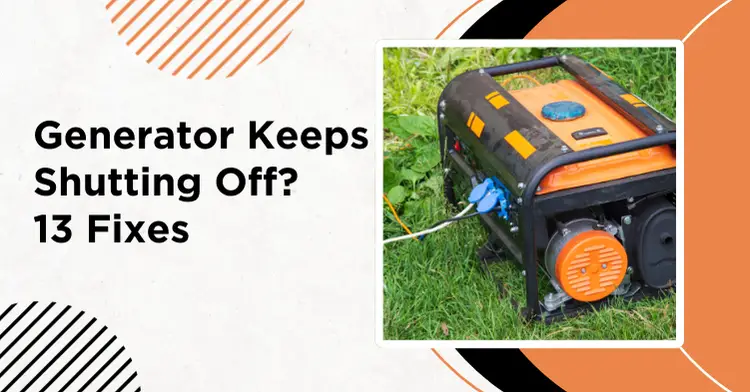
Generator Keeps Shutting Off? 13 Causes and How to Fix Each One
Updated: April 1, 2026A generator that keeps shutting off mid-use is more than just annoying. It can leave you without power when you need it most. Whether it cuts out after 10 minutes, dies under heavy load, or randomly stops for no apparent reason, the cause is almost always identifiable and fixable.
Our team has troubleshot this exact problem across dozens of generator brands and models. The key to a fast diagnosis? Pay attention to when it shuts off. The timing tells you almost everything you need to know about what’s wrong.
This guide covers 13 causes ranked by how common they are, with step-by-step fixes for each one. We also include brand-specific tips for Honda, Generac, Champion, and other popular models.
Contents
- 1 Quick Diagnosis: When Does Your Generator Shut Off?
- 2 13 Reasons Your Generator Keeps Shutting Off (and How to Fix Each One)
- 2.1 1. Overloading: Too Many Appliances Connected
- 2.2 2. Fuel Cap Vent Blockage: The Hidden 15-Minute Killer
- 2.3 3. Choke Left in the Wrong Position
- 2.4 4. Low Oil Sensor Triggering a False Shutdown
- 2.5 5. Dirty or Clogged Carburetor
- 2.6 6. Old or Contaminated Fuel
- 2.7 7. Engine Overheating
- 2.8 8. Loose or Corroded Wiring
- 2.9 9. Clogged Spark Arrestor
- 2.10 10. CO Sensor Shutoff (Modern Generators)
- 2.11 11. GFCI Outlet Tripping (Inverter Generators)
- 2.12 12. Vapor Lock (Hot Weather)
- 2.13 13. Failing Ignition Coil
- 3 Brand-Specific Shutoff Issues
- 4 Step-by-Step Troubleshooting Process
- 5 Tools and Parts You Might Need
- 6 How to Prevent Your Generator From Shutting Off
- 7 When to Call a Professional
- 8 Frequently Asked Questions
- 8.1 Why does my generator shut off after 20-30 minutes?
- 8.2 Why does my generator shut off when I turn on the AC?
- 8.3 Can low oil cause a generator to shut off?
- 8.4 Why does my generator keep shutting off under load?
- 8.5 My generator shuts off and won’t restart until it cools down. What’s wrong?
- 8.6 Why does my generator shut off in cold weather?
- 8.7 Is it normal for a generator to shut off by itself?
- 8.8 How do I reset my generator after it shuts off?
- 9 Related Troubleshooting Guides
- 10 Final Thoughts
Quick Diagnosis: When Does Your Generator Shut Off?
Before diving into specific causes, use this timing chart to narrow down the problem fast. The moment your generator shuts off reveals a lot about the root cause.
| When It Shuts Off | Most Likely Causes | Start With |
|---|---|---|
| Within 30 seconds | Choke position, low oil sensor, stale fuel | Causes #3, #4, #6 |
| After 5-15 minutes | Fuel cap vent blockage, carburetor issues, spark arrestor | Causes #2, #5, #9 |
| After 20-60 minutes | Overheating, vapor lock, coolant (standby units) | Causes #7, #12 |
| When you plug something in | Overloading, GFCI tripping, AVR failure | Causes #1, #10, #11 |
| Randomly / no pattern | Faulty oil sensor, loose wiring, ignition coil | Causes #4, #8, #13 |
Now let’s walk through each cause in detail, starting with the most common ones.
13 Reasons Your Generator Keeps Shutting Off (and How to Fix Each One)
1. Overloading: Too Many Appliances Connected
This is the single most common reason a generator shuts off during use. Every generator has a rated wattage (continuous) and a surge wattage (peak). When the combined load of your connected appliances exceeds the rated capacity, the generator’s circuit breaker trips or the engine bogs down and stalls.
Symptoms:
- Generator shuts off the moment you plug in a high-draw appliance (AC unit, microwave, power tools)
- Lights dim or flicker before the shutdown
- Circuit breaker on the generator panel has tripped
- Engine sounds strained or RPM drops noticeably before stopping
How to fix it:
- Disconnect all appliances from the generator
- Reset the circuit breaker (usually a button on the control panel)
- Restart the generator and let it stabilize for 2-3 minutes
- Reconnect appliances one at a time, starting with the highest-draw items first
- Add up the running watts of everything connected and stay under 80% of rated capacity
Pro tip: Motor-driven appliances like refrigerators and AC units draw 2-3x their running watts when they first start. A 1,500W AC unit might spike to 4,500W for a split second. If your generator can’t handle that surge, stagger your startup. Turn on the AC first, wait 30 seconds, then plug in other items.
For a detailed walkthrough, see our complete overloaded generator troubleshooting guide.
Difficulty: Easy | Cost: $0 | Time: 5 minutes
2. Fuel Cap Vent Blockage: The Hidden 15-Minute Killer
This is the cause most people miss, and it perfectly explains a generator that runs fine for 10-20 minutes and then dies. Your fuel cap has a small vent hole that lets air into the tank as fuel is consumed. If that vent gets clogged with dirt or debris, a vacuum builds inside the tank and eventually stops fuel from flowing to the carburetor.
Symptoms:
- Generator runs well for 10-20 minutes, then sputters and dies
- It restarts fine after sitting for a few minutes (vacuum releases)
- The problem repeats at roughly the same time interval
The quick test: Next time the generator dies, immediately loosen the fuel cap. If you hear a hiss of air being sucked in, you’ve found the problem.
How to fix it:
- Remove the fuel cap and inspect the vent hole (usually a tiny pinhole on the cap or a small tube)
- Clean the vent with a thin wire, needle, or compressed air
- If the cap is damaged or the vent won’t clear, replace the fuel cap ($8-15 on Amazon)
Prevention: Wipe the fuel cap area clean before refueling. Store the generator with the cap area protected from dust.
Difficulty: Easy | Cost: $0-15 | Time: 5 minutes
3. Choke Left in the Wrong Position
The choke controls the air-fuel mixture during startup. A cold engine needs a rich mixture (choke ON/CLOSED), but once warmed up, it needs normal airflow (choke OFF/OPEN/RUN). Leaving the choke on after the engine warms up floods it with too much fuel, causing it to stumble and die.
Symptoms:
- Generator starts fine but dies within 1-3 minutes
- Black smoke from the exhaust (too rich)
- Engine sounds rough or “loaded” before dying
The proper choke sequence:
- Start: Choke fully ON (closed)
- After 30-60 seconds: Move to HALF choke
- After 2-3 minutes (engine warm): Move to RUN/OFF (fully open)
If your generator dies when you move the choke to RUN, the problem is likely a dirty carburetor, not the choke itself. The engine can’t maintain a proper fuel mixture without the choke enriching it. See Cause #5 below.
For Honda owners dealing with this: see our Honda generator only runs with choke on troubleshooting guide.
Difficulty: Easy | Cost: $0 | Time: Immediate
4. Low Oil Sensor Triggering a False Shutdown
Most modern generators have a low-oil shutoff sensor that kills the engine when oil drops below a safe level. This is a critical safety feature because running without oil destroys the engine in minutes. But these sensors can also cause false shutdowns when the oil level is actually fine.
When it’s a real low-oil shutdown:
- Check the dipstick. If oil is below the low mark, add the correct oil type and weight
- Always check oil on a level surface. An uneven surface can cause the sensor to misread
When the sensor is faulty (false shutdown):
- Oil level shows full on the dipstick, but the generator still shuts off
- Generator shuts off randomly, sometimes after 5 minutes, sometimes after an hour
- The problem gets worse on uneven ground or when the generator vibrates heavily
How to fix a faulty sensor:
- Verify oil is at the correct level on a flat, hard surface
- Drain and refill with fresh oil (old oil can cause sensor issues)
- If the problem continues, locate the oil pressure switch (usually near the crankcase) and inspect the wire connection, since vibration can loosen it over time
- As a temporary test only, disconnect the sensor wire and run the generator briefly to confirm the sensor is the problem
- Replace the sensor ($10-25 on Amazon for most models)
Difficulty: Moderate | Cost: $10-25 | Time: 30-60 minutes
5. Dirty or Clogged Carburetor
The carburetor mixes fuel and air in the right ratio for combustion. When old fuel leaves varnish deposits or dirt clogs the tiny jets inside, the engine can’t get enough fuel and shuts down. This is especially common under load or after the engine has warmed up.
Symptoms:
- Generator only runs with choke on (needs the richer mixture to compensate)
- Engine sputters, surges, or hunts before dying
- Gets worse over time or after storage
- Generator starts fine when cold but dies as it warms up
How to fix it:
- Quick clean (no removal): Add a carburetor cleaner additive like Sea Foam SF-16 to the fuel tank and run for 15-20 minutes. Works for minor buildup.
- Full clean: Remove the carburetor bowl (usually one bolt at the bottom). Clean the main jet with a carburetor cleaner spray and a thin wire. Clear all passages with compressed air.
- Rebuild or replace: If cleaning doesn’t work, a replacement carburetor for most portable generators costs $15-30 on Amazon and takes 20-30 minutes to swap.
If your generator has been sitting with old fuel for more than 30 days, a dirty carburetor is very likely. See our guide to fixing a generator with old gas for the full fuel system cleaning process.
Difficulty: Moderate | Cost: $8-30 | Time: 30-90 minutes
6. Old or Contaminated Fuel
Gasoline starts degrading after just 30 days. After 3-6 months, it can form varnish, gum up fuel lines, and clog the carburetor. Ethanol-blended fuel (E10 or E15) is especially problematic because ethanol attracts moisture and accelerates degradation.
Signs of bad fuel:
- Fuel smells sour or like varnish instead of sharp gasoline
- Fuel looks dark yellow or brown instead of clear
- You can see water droplets or separation layers in the tank
- Generator ran fine last season but struggles now
How to fix it:
- Drain the old fuel completely from the tank, fuel lines, and carburetor bowl
- Fill with fresh, high-quality gasoline (use ethanol-free if available)
- Add fuel stabilizer to the fresh fuel (prevents future degradation)
- Run the generator for 10-15 minutes to cycle fresh fuel through the system
Prevention: Always add fuel stabilizer when storing your generator for more than 2 weeks. STA-BIL Storage Fuel Stabilizer or Sea Foam SF-16 extends fuel life to 12-24 months. This single habit prevents the majority of generator fuel problems.
Difficulty: Easy | Cost: $10-20 (fresh gas + stabilizer) | Time: 20-30 minutes
7. Engine Overheating
Generators produce enormous heat during operation. Air-cooled portable generators rely on airflow through cooling fins to manage temperature. When cooling is compromised, the engine hits a thermal limit and shuts down to protect itself.
Symptoms:
- Generator runs fine for 20-60 minutes, then dies
- Restarts after cooling down (15-30 minutes), then repeats the cycle
- Noticeably hotter to the touch than usual
- Worse on hot days or when the generator is in direct sunlight
Common overheating causes:
- Blocked cooling fins: Dirt, debris, or grass clippings packed between the engine fins restrict airflow. Clean with compressed air or a soft brush.
- Broken cooling fan or shroud: The fan or the plastic shroud that directs air over the engine may be cracked or missing.
- Operating in an enclosed or tight space: The generator needs at least 3-5 feet of clearance on all sides.
- Low oil: Oil doesn’t just lubricate. It also helps carry heat away from engine components. Low oil accelerates overheating.
- Running at or near full capacity: A continuously overloaded generator produces more heat than the cooling system can handle.
How to fix it:
- Move the generator to a well-ventilated area with shade if possible
- Clean the cooling fins and fan area thoroughly
- Check oil level and top up if needed
- Reduce the electrical load to 75-80% of rated capacity
- Let the engine cool for 30 minutes before restarting
Difficulty: Easy to Moderate | Cost: $0-10 | Time: 15-30 minutes
8. Loose or Corroded Wiring
Vibration is a generator’s constant companion, and over time it loosens electrical connections. A single loose wire can cause intermittent shutdowns that seem completely random, which makes this one of the hardest problems to diagnose.
Symptoms:
- Shutdowns at random intervals with no consistent pattern
- Problem gets worse when the generator vibrates heavily (uneven surface, heavy load)
- Sometimes the generator runs for hours without issue, other times it dies in minutes
- You notice corrosion (green or white buildup) on wire terminals
How to fix it:
- With the generator OFF and spark plug wire disconnected, visually inspect all accessible wiring
- Check the connections at the oil pressure sensor, ignition coil, and control panel
- Wiggle each connection gently. Loose ones will move
- Clean corroded terminals with electrical contact cleaner and a wire brush
- Tighten all connections and apply dielectric grease to prevent future corrosion
Difficulty: Moderate | Cost: $0-10 | Time: 30-60 minutes
9. Clogged Spark Arrestor
The spark arrestor is a small mesh screen in the muffler that prevents hot carbon particles from leaving the exhaust (a fire safety requirement). Over hundreds of hours of use, carbon deposits build up on this screen, restricting exhaust flow. The engine can’t breathe out, so it suffocates and stalls.
Symptoms:
- Generator loses power gradually over weeks or months
- Engine bogs down under load
- Shutdowns happen more frequently as the clog worsens
- You notice reduced exhaust output
How to fix it:
- Let the generator cool completely
- Remove the spark arrestor screen (usually accessible by removing the muffler cover; check your manual for the exact location)
- Use a wire brush to scrub off the carbon buildup
- Hold it up to light. You should be able to see clearly through the mesh
- If badly clogged, use a propane torch to burn off carbon deposits, then brush clean
- Reinstall and test
For spark plug maintenance that often goes hand-in-hand with this issue, see our spark plug comparison and replacement guide.
Difficulty: Easy | Cost: $0 (cleaning) or $5-15 (replacement) | Time: 15-30 minutes
10. CO Sensor Shutoff (Modern Generators)
Since 2020, many portable generators include a built-in carbon monoxide (CO) sensor that automatically shuts down the engine if CO levels get too high near the unit. This is a lifesaving feature, but it can also trigger false shutdowns in certain conditions.
When the CO shutoff is legitimate:
- Generator is in an enclosed or semi-enclosed space. Move it immediately.
- Too close to walls, corners, or overhangs that trap exhaust
When it may be a false trigger:
- Generator is outdoors in open air but wind blows exhaust back toward the sensor
- Multiple generators running nearby
- Generator positioned downwind from a vehicle or other exhaust source
- Sensor is contaminated with dirt or moisture
How to fix false CO shutdowns:
- Reposition the generator so the exhaust points away from the wind direction
- Ensure at least 20 feet of clearance from any structure
- Clean the CO sensor area with compressed air (check your manual for sensor location)
- If the sensor continues to malfunction, contact the manufacturer for a replacement
For a deeper look at Honda’s CO-MINDER system and troubleshooting, read our Honda CO sensor guide.
Difficulty: Easy | Cost: $0 | Time: 5 minutes (repositioning)
11. GFCI Outlet Tripping (Inverter Generators)
Many modern inverter generators have built-in GFCI (Ground Fault Circuit Interrupter) outlets. These outlets detect even tiny imbalances in electrical current and trip instantly to prevent electrocution. However, certain loads can cause nuisance tripping, especially long extension cords, older tools, and some appliances with motors.
Symptoms:
- The outlet stops producing power, but the engine keeps running
- The GFCI reset button on the outlet panel has popped out
- Happens when connecting specific appliances (especially ones with motors)
How to fix it:
- Press the GFCI reset button on the generator’s outlet panel
- If it trips again immediately, the connected appliance may have a ground fault. Test with a different appliance
- Use shorter extension cords (long cords increase the chance of nuisance trips)
- Ensure extension cords are not damaged, wet, or coiled tightly (heat buildup)
- If the GFCI trips with no load connected, the outlet itself may be faulty and should be replaced ($15-25)
Note: This technically doesn’t shut off the generator engine — but the result feels the same: no power at the outlets. Check whether the engine is still running before assuming it’s a shutdown issue.
Difficulty: Easy | Cost: $0-25 | Time: 5-15 minutes
12. Vapor Lock (Hot Weather)
Vapor lock happens when fuel in the lines or carburetor gets so hot it turns from liquid to vapor. The fuel pump can’t move vapor effectively, so fuel delivery drops and the engine starves. This is most common during extreme heat (above 95°F / 35°C) or when the generator runs for extended periods in direct sunlight.
Symptoms:
- Generator dies after running for 30+ minutes on a hot day
- Won’t restart immediately, but starts fine after cooling for 15-20 minutes
- More common with generators that have fuel lines routed near the exhaust
How to fix it:
- Move the generator to a shaded area
- Let it cool for 15-20 minutes
- Place a wet cloth on the fuel line and carburetor area to help cool them faster
- Consider installing a heat shield between the exhaust and fuel lines if this happens repeatedly
Prevention: On hot days, set up the generator in the shade. Keep the fuel tank at least half full (more fuel = slower heating). If you run the generator for extended hours in summer, periodic 15-minute cooldown breaks can prevent vapor lock.
Difficulty: Easy | Cost: $0 | Time: Wait 15-20 minutes
13. Failing Ignition Coil
The ignition coil generates the high-voltage spark that fires the spark plug. When a coil starts failing, it often works fine when cold but breaks down as it heats up during operation. This creates the classic “heat soak” failure: the generator runs for a while, then dies and won’t restart until it cools down.
Symptoms:
- Generator dies after 15-45 minutes and won’t restart while hot
- Restarts normally once completely cool
- Spark plug looks fine and has proper gap
- Fuel system checks out OK
How to test:
- When the generator dies, immediately remove the spark plug
- Reconnect the spark plug wire with the plug grounded against the engine block
- Pull the starter — you should see a bright blue spark
- If there’s no spark (or a weak orange/yellow spark), the ignition coil is likely the problem
How to fix: Replace the ignition coil. For most portable generators, this costs $15-40 for the part and takes about 30 minutes. It’s held on by 2 bolts and has one wire connection.
Difficulty: Moderate | Cost: $15-40 | Time: 30 minutes
Brand-Specific Shutoff Issues
Different brands have their own quirks when it comes to unexpected shutdowns. Here are the most common brand-specific issues we see.
Honda Generators (EU2200i, EU3000is, EB Series)
| Issue | Cause | Fix |
|---|---|---|
| Dies when choke moved to RUN | Clogged pilot jet in carburetor | Clean carb with pilot jet wire ($5 kit) |
| CO-MINDER shuts off engine outdoors | Wind blowing exhaust toward CO sensor | Reposition — exhaust away from wind |
| Eco-Throttle causes stalling | Engine can’t handle load surges at low RPM | Turn Eco-Throttle OFF when running heavy loads |
| Dies after 10-15 minutes | Fuel cap vent blockage | Loosen cap to test, then clean the vent |
Related: Honda Generator Only Runs With Choke On – Complete Fix
Generac Generators (GP Series, iQ Series, Standby Units)
| Issue | Cause | Fix |
|---|---|---|
| Red light on + shutdown | Low oil, overload, overheating, or RPM sense loss | Check our red light troubleshooting guide |
| Error code 1501 (overcrank) | Engine cranks but won’t catch; fuel or ignition issue | Check our Generac 1501 troubleshooting guide |
| Sensitive low-oil sensor | Sensor trips on slight slopes or after oil change | Level the unit, verify oil level, reset after oil change |
| Weekly test fails / shuts off | Low battery, stale fuel, or control board issue | Check our weekly test troubleshooting guide |
Related: Why Your Generac Generator Won’t Start – 8 Solutions
Champion Generators (Dual Fuel, Open Frame, Inverter)
| Issue | Cause | Fix |
|---|---|---|
| Shuts off on propane but runs on gas | Propane regulator issue or low tank pressure | Check regulator, try a different propane tank |
| Economy mode stalling | Fluctuating loads cause engine to drop too low | Turn off Economy mode for variable loads |
| Volt Guard trips frequently | Voltage spikes from motor-driven loads | Stagger startup of appliances, check AVR |
Related: Champion Generator Troubleshooting – Complete Guide
Westinghouse and DuroMax Generators
| Brand | Common Shutoff Issue | Fix |
|---|---|---|
| Westinghouse | Indicator light stays on after shutdown | See our Westinghouse light guide |
| Westinghouse | Dual-fuel switch causes stalling when switching | Always switch fuel types with engine OFF |
| DuroMax | Engine dies when switching from gas to propane | Let gas run out first, then switch to propane and restart |
| DuroMax | Electric start drains battery, generator won’t stay running | Charge/replace battery, use pull-start as backup |
Related: DuroMax XP12000EH Troubleshooting Guide | Westinghouse Light Troubleshooting
Step-by-Step Troubleshooting Process
If you’re not sure where to start, follow this sequence. It’s ordered from quickest/easiest checks to more involved diagnostics.
- Check the obvious: Fuel level, oil level (on a flat surface), and choke position
- Check the circuit breaker: Reset if tripped, reduce load before restarting
- Test the fuel cap: Loosen it and listen for a hiss. If yes, clean the vent
- Inspect the air filter: Remove and hold up to light. Replace if clogged
- Check the spark plug: Remove, inspect for fouling or damage, check gap. Replace if worn.
- Examine the spark arrestor: Remove from muffler, brush clean, check for airflow
- Assess fuel quality: Drain if old or smells bad, refill with fresh fuel + stabilizer
- Check for overheating: Clean cooling fins, ensure proper ventilation
- Inspect wiring: Look for loose connections, corrosion, damaged insulation
- Test the ignition coil: Spark test when engine is hot (if it dies after running)
If you’ve worked through all 10 steps and the generator still shuts off unexpectedly, it may be an internal engine issue (worn piston rings, valve problems) or a faulty control board. At that point, a qualified small engine mechanic is your best bet.
Tools and Parts You Might Need
| Item | Used For | Approx. Cost |
|---|---|---|
| Spark plug wrench + gap tool | Removing and checking spark plugs | $5-10 |
| Gumout Carb/Choke Cleaner | Cleaning jets and passages | Check price |
| STA-BIL Fuel Stabilizer | Preventing fuel degradation during storage | Check price |
| Champion RC12YC spark plug (4-pack) | Replacing fouled or worn plug | Check price |
| Replacement air filter | Replacing clogged filter | $5-15 |
| Inline fuel filter | Catching debris before the carburetor | $5-8 |
| Replacement fuel cap | Fixing blocked vent | $8-15 |
| Multimeter | Testing voltage output and ignition coil | $15-30 |
| Low oil pressure sensor | Replacing faulty shutoff sensor | $10-25 |
How to Prevent Your Generator From Shutting Off
Most unexpected shutdowns are preventable with basic maintenance. Follow this schedule:
| When | What to Do |
|---|---|
| Before every use | Check oil level, check fuel level and quality, inspect air filter |
| Every 50 hours | Change oil, clean or replace air filter, check spark plug |
| Every 100 hours | Replace spark plug, clean spark arrestor, inspect fuel lines |
| Before storage (30+ days) | Add fuel stabilizer, run for 10 min to circulate, turn off fuel valve |
| Before storm season | Full maintenance check, test run for 30 minutes under load, stock spare parts |
For new generators, a proper break-in procedure during the first 5 hours sets the foundation for reliable long-term operation.
When to Call a Professional
- You smell gas but can’t find the source (fire risk)
- The generator makes grinding, knocking, or metallic sounds
- You’ve tried all the fixes above and it still shuts off
- The control board shows error codes you can’t resolve
- There are signs of internal engine damage (metal in oil, blue/white smoke)
- Any repair requires disassembling the engine block
A qualified small engine mechanic typically charges $50-100/hour. For older generators, compare the estimated repair cost against a replacement. Sometimes it’s more economical to upgrade.
Frequently Asked Questions
Why does my generator shut off after 20-30 minutes?
The most common causes for a 20-30 minute shutdown are overheating (blocked cooling fins or poor ventilation), fuel cap vent blockage (vacuum builds in the tank), or vapor lock on hot days. Start by checking the fuel cap vent — loosen the cap and listen for a hiss of air.
Why does my generator shut off when I turn on the AC?
Air conditioners draw 2-3 times their rated wattage during startup. If your generator’s surge rating can’t handle that spike, it will overload and shut down. Either use a generator with a higher surge rating, start the AC first before other loads, or consider a soft-start kit for your AC unit.
Can low oil cause a generator to shut off?
Yes. Most modern generators have a low-oil shutoff sensor that automatically kills the engine when oil drops below a safe level. This prevents catastrophic engine damage. Always check oil on a flat, level surface before each use.
Why does my generator keep shutting off under load?
If the generator runs fine at idle but dies under load, the most likely causes are overloading (too many appliances), a dirty carburetor (can’t deliver enough fuel under demand), a clogged air filter, or a failing automatic voltage regulator (AVR).
My generator shuts off and won’t restart until it cools down. What’s wrong?
This is a classic sign of either engine overheating or a failing ignition coil. Both problems cause the generator to die when hot and work again once cool. Check the cooling fins for blockage first. If cooling is fine, test for spark when the engine is hot — no spark means the ignition coil needs replacement.
Why does my generator shut off in cold weather?
Cold temperatures thicken oil (making the low-oil sensor more likely to trip), reduce battery power for electric-start models, and can cause fuel line issues. Use the correct cold-weather oil weight, keep the battery charged, and store fuel with stabilizer. See our cold weather generator troubleshooting guide for detailed steps.
Is it normal for a generator to shut off by itself?
Some shutoffs are designed and normal: low-oil protection, CO sensor activation, overload protection, and fuel running out. But if the generator shuts off repeatedly during normal use with adequate fuel and oil, something needs attention. Use the timing chart at the top of this article to narrow down the cause.
How do I reset my generator after it shuts off?
First, identify why it shut off (check oil, fuel, circuit breaker, and error lights). Fix the underlying cause. Then: turn the generator OFF, wait 30 seconds, reset any tripped circuit breakers, and restart. For Generac standby units with a red light, see our Generac red light troubleshooting guide.
Related Troubleshooting Guides
- Generator Starts Then Dies: 10 Causes and Fixes
- Generator Surging: Why It Revs Up and Down
- Generator Runs But No Power Output
- How to Fix an Overloaded Generator
- How to Fix a Generator with Old Gas
- Generac Generator Red Light On
- Champion Generator Troubleshooting Guide
- DuroMax XP12000EH Troubleshooting
Final Thoughts
A generator that keeps shutting off is trying to tell you something. In most cases, the fix is straightforward — a clogged fuel cap vent, dirty carburetor, overloaded circuit, or low oil. The timing diagnostic chart at the top of this article will point you toward the right cause 90% of the time.
Start with the easiest checks (fuel, oil, choke, circuit breaker) and work your way through the list. Most of these fixes cost nothing or under $30 in parts, and you can do them in your driveway with basic tools.
If your generator is heading into storage, take five minutes to add fuel stabilizer and run it through the system. That single step prevents the most common reason generators fail when you need them most.
As an Amazon Associate I earn from qualifying purchases.