
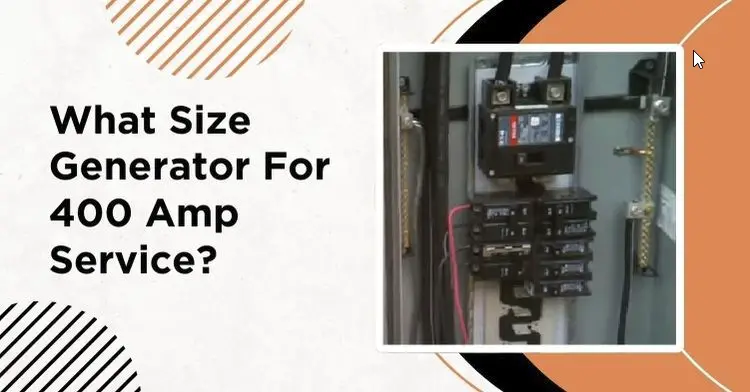
What Size Generator For 400 Amp Service?
Updated: April 1, 2026
What size generator for 400 amp service? A 38 to 50 kW standby generator covers most homes with 400 amp panels. With load management modules, some homeowners get full coverage from a 22 to 26 kW unit. The theoretical maximum is 96 kW (400A x 240V), but no home draws that much power at once.
Sizing a generator by matching the panel rating is the most common and most expensive mistake homeowners make. A 400 amp panel at 240 volts equals 96,000 watts on paper. After applying NEC Article 220 demand factors and accounting for real-world usage, the actual calculated load falls between 150 and 200 amps for most homes. That translates to 36,000 to 48,000 watts.
This guide breaks down the correct sizing method, compares the two main approaches (full-home backup vs. essential loads with load management), and covers specific generator and transfer switch options with current pricing.
Contents
- 1 Who Actually Has 400 Amp Service?
- 2 Essential Loads vs. Whole House: The Real Decision
- 3 What Size Generator for 400 Amp Service?
- 4 Best Generators for 400 Amp Service (2026)
- 5 Transfer Switches: Single 400A vs. Dual 200A
- 6 How to Calculate Your Actual Generator Size
- 7 Total Installed Cost
- 8 Protect Your Electronics During Transfer
- 9 What About 500 and 600 Amp Service?
- 10 NEC Code Requirements
- 11 Frequently Asked Questions (FAQs):
- 11.1 How many watts is 400 amp service?
- 11.2 Do you need a 96 kW generator for 400 amp service?
- 11.3 How much does a generator for 400 amp service cost?
- 11.4 Single 400A transfer switch or dual 200A switches?
- 11.5 What size generator for 500 amp service?
- 11.6 What size generator for 600 amp service?
- 11.7 Can I use a portable generator for 400 amp service?
Who Actually Has 400 Amp Service?
Until a few years ago, 400 amp residential service was rare. That changed fast. Three trends are pushing homes past 200 amps:
- Electric vehicles. A single Level 2 EV charger on a 48-amp circuit draws about 9,600 watts. A two-car household with two chargers needs 19,200 watts just for charging.
- All-electric homes. Heat pump HVAC, electric water heater, electric range, and electric dryer combine for 30,000+ watts. Without gas appliances sharing the load, the panel fills up fast.
- Pools, hot tubs, and workshops. An electric pool heater pulls up to 11,000 watts. A hot tub adds 7,500 watts. A 240-volt welder can draw 12,000 watts alone.
Here is what a typical 400 amp home’s load looks like:
| Appliance | Running Watts | Starting Watts |
|---|---|---|
| Central AC (5-ton) | 6,000 W | 12,000 W |
| Heat pump / electric furnace | 10,000 W | 10,000 W |
| Electric range | 5,000 W | 5,000 W |
| Electric dryer | 5,400 W | 6,750 W |
| Electric water heater | 4,500 W | 4,500 W |
| 2 EV chargers (Level 2) | 19,200 W | 19,200 W |
| Pool pump + heater | 8,000 W | 12,000 W |
| Hot tub (50A circuit) | 7,500 W | 7,500 W |
| Lighting + general circuits | 5,000 W | 5,000 W |
| Workshop equipment | 10,000 W | 15,000 W |
| Total | 80,600 W | 96,950 W |
At 240 volts, 80,600 watts equals about 336 amps. That exceeds a 200 amp service panel, which is why these homes need 400 amps.
Good to know: Most 400 amp residential setups use two 200 amp panels fed from a 400 amp meter base. This is cheaper and more practical than a single 400 amp panel. The NEC allows it, and most electricians prefer it.
Essential Loads vs. Whole House: The Real Decision
Before picking a generator size, answer one question: Do you need everything running during a power outage, or just the essentials?
This decision has a bigger impact on cost than any other factor.
| Essential Loads Only | Whole House Backup | |
|---|---|---|
| What runs | HVAC, fridge, lights, sump pump, one EV charger, well pump | Everything on both panels |
| Generator size | 22 to 26 kW | 38 to 50 kW |
| Generator cost | $5,500 to $8,000 | $14,000 to $25,000 |
| Requires load management? | Yes | No |
| Total installed cost | $12,000 to $18,000 | $22,000 to $40,000 |
Many homeowners with 400 amp service choose the essential loads approach. A 26 kW generator with Generac Smart Management Modules can cycle heavy loads like the AC, pool heater, and EV charger so they never run simultaneously. The generator handles the total demand by staggering when each load turns on.
Each Smart Management Module controls one 50-amp circuit. Most 400 amp homes need 3 to 4 modules ($150 to $190 each) to cover the major loads. That $600 investment in modules can save $10,000+ on the generator itself.
What Size Generator for 400 Amp Service?
The Calculation
Generator sizing uses a simple formula:
Watts = Amps x Volts
For a 400 amp panel at 240 volts (standard residential split-phase):
400A x 240V = 96,000 watts = 96 kW
That is the theoretical maximum. Three factors reduce the actual requirement:
- NEC Article 220 demand factors. The National Electrical Code recognizes that circuits never all run at full load simultaneously. General lighting uses 100% of the first 3,000 VA and 35% of the remainder. Only the larger of heating or cooling counts, not both.
- Real usage patterns. Nobody runs the oven, dryer, both EV chargers, pool heater, and welder at the same time.
- Load management. Modern transfer switches shed non-essential loads automatically during peak demand.
After applying these factors, most 400 amp homes need 36 to 48 kW for full backup, or 22 to 26 kW with load management.
Generator Size by Voltage and Phase
| Service | Voltage | Phase | Max (Theoretical) | Recommended Size |
|---|---|---|---|---|
| 400 Amp | 240V (residential) | Split-phase | 96 kW | 38 to 50 kW |
| 400 Amp | 208V (commercial) | Three-phase | 144 kW | 100 to 125 kW |
| 400 Amp | 480V (industrial) | Three-phase | 333 kW | 250 to 300 kW |
Recommended sizes include a 20% safety margin above NEC-calculated demand. Actual requirements depend on connected loads.
Best Generators for 400 Amp Service (2026)
Generators above 26 kW use liquid-cooled engines and are sold through authorized dealers, not retail stores. Air-cooled units (up to 26 kW) are available on Amazon and work well for 400 amp service when paired with load management.
Option 1: Air-Cooled with Load Management (22 to 26 kW)
This is the most cost-effective approach for 400 amp homes where full-panel backup is not required.
| Generator | Output | Fuel | Price Range | Notes |
|---|---|---|---|---|
| Generac Guardian 26 kW | 26 kW / 108A at 240V | NG / LP | $6,500 to $7,500 | Largest air-cooled Generac. WiFi enabled. 5-year warranty. |
| Generac Guardian 24 kW | 24 kW / 100A at 240V | NG / LP | $6,000 to $6,500 | Mid-range. Same engine as 26 kW. Dual fuel. |
| Kohler 26 kW | 26 kW / 108A at 240V | NG / LP | $7,500 to $8,200 | Aluminum enclosure. 18-inch clearance. Quieter. 5-year warranty. |
Pair any of these with 3 to 4 Smart Management Modules ($150 to $190 each) and a Generac RTSW400A3 transfer switch for complete 400 amp coverage.
Option 2: Liquid-Cooled for Full Backup (38 to 50 kW)
These generators handle the full calculated demand without load shedding. They run through authorized dealers and require professional installation.
| Generator | Output | Fuel | Price Range | Notes |
|---|---|---|---|---|
| Generac Protector QS 38 kW | 38 kW / 158A at 240V | NG / LP | $19,000 to $20,000 | 2.4L liquid-cooled. True Power (<5% THD). 5-year warranty. |
| Kohler 38RCLC | 38 kW / 158A at 240V | NG / LP | $14,000 to $16,200 | 61 dBA (quietest in class). Hydraulic valve lifters. 5-year warranty. |
| Cummins RS40 | 40 kW / 167A at 240V | NG / LP | $18,000 to $22,000 | 180 MPH wind-rated enclosure. Starts at -40°F. 2-year warranty. |
| Generac Protector 48 kW | 48 kW / 200A at 240V | NG / LP | $22,000 to $25,000 | 4.5L engine. Full 200A per panel. For max coverage. |
| Cummins RS50 | 50 kW / 208A at 240V | NG / LP | $22,000 to $28,000 | Quietest 50 kW available. Commercial-grade reliability. |
Professional installers generally rank reliability as Cummins first, Kohler second, Generac third. Generac has the largest dealer network and parts availability. Kohler offers the best price-to-quality ratio in the 38 kW class.
Transfer Switches: Single 400A vs. Dual 200A
Since most 400 amp homes have two 200 amp panels, there are two ways to set up the transfer switch. This choice affects both cost and generator compatibility.
| Single 400A Switch | Dual 200A Switches | |
|---|---|---|
| Equipment cost | $2,800 to $3,500 | $1,400 to $1,600 (2 x $700) |
| Installation | Simpler (one connection) | More wiring, two connections |
| Load management | Built-in (4 to 6 loads) | Separate modules needed |
| Parts availability | Limited, expensive | Common, affordable |
| Physical size | Large and heavy | Two smaller units |
| Best for | Generators over 200A output | Generators under 200A output |
Most electricians prefer the dual 200A setup. It saves $1,200+ on equipment, uses standard parts that every supply house stocks, and service technicians carry replacements on their trucks. A single 400A switch makes sense only when the generator outputs more than 200 amps (48+ kW units).
400 Amp Transfer Switch Options
| Switch | Rating | Load Management | Price |
|---|---|---|---|
| Generac RTSW400A3 | 400A, Service Entrance | 4 HVAC loads built-in | $3,100 to $3,200 |
| Kohler RXT-JFNC-400ASE | 400A, Service Entrance | 6 loads (4 non-essential + 2 HVAC) | ~$3,500 |
| Cummins RA-400-SE | 400A, Service Entrance | Standard load shedding | $2,800 to $3,200 |
All switches above are NEMA 3R rated (indoor/outdoor) and UL 1008 listed. The Kohler manages the most individual loads at six. With installation labor, expect to pay $3,500 to $6,000 total.
No interlock kits for 400A: Interlock kits only exist for panels up to 200 amps. With 400 amp service, an automatic transfer switch is the only code-compliant option.
How to Calculate Your Actual Generator Size
The panel rating does not determine your generator size. The connected load does. Here is how to figure out what you actually need.
Step 1: List every circuit on both panels. Write down each breaker, its amperage, and what it powers.
Step 2: Measure actual usage. Plug a Kill A Watt electricity monitor into each 120V appliance to measure its real power draw. For 240V circuits (AC, dryer, EV charger), check the nameplate rating on the unit or the owner’s manual.
Step 3: Separate running watts from starting watts. Motors draw 2 to 3 times their running wattage at startup. A 5-ton central AC runs at about 6,000 watts but surges to 12,000 watts when the compressor kicks on.
Step 4: Apply the largest-motor rule. Add the running watts of everything you want to power. Then add the starting watts of only the single largest motor. This gives your realistic peak demand.
Step 5: Add a 20% margin. Multiply by 1.2 for future additions and measurement uncertainty.
For the most accurate result, hire a licensed electrician to perform a full NEC Article 220 load calculation. This is what building inspectors require for permitted generator installations.
Total Installed Cost
| Component | Essential Loads (22-26 kW) | Whole House (38-50 kW) |
|---|---|---|
| Generator | $5,500 to $8,000 | $14,000 to $25,000 |
| Transfer switch | $1,400 to $3,200 | $2,800 to $3,500 |
| Load management modules | $450 to $760 (3-4 units) | Not needed |
| Installation labor | $2,500 to $4,000 | $3,000 to $5,000 |
| Concrete pad | $800 to $1,200 | $800 to $1,200 |
| Gas line (if needed) | $500 to $2,500 | $500 to $2,500 |
| Electrical wiring | $800 to $2,000 | $1,000 to $3,000 |
| Permits | $80 to $450 | $80 to $450 |
| Total | $12,030 to $22,110 | $22,180 to $43,650 |
These figures assume the 400 amp service already exists. Upgrading from 200 amp to 400 amp adds $8,000 to $12,000 for the meter base, panels, and utility coordination.
Annual maintenance runs $300 to $600 per year. A Generac maintenance kit covers air filter, oil filter, spark plugs, and pre-cleaner for the 22 to 26 kW models.
Protect Your Electronics During Transfer
When a generator starts and the transfer switch activates, there is a brief moment where voltage fluctuates. This can damage sensitive electronics like computers, smart home systems, and networking equipment.
A whole-house surge protector installed at the main panel absorbs these spikes. At around $100 for the unit, it is cheap insurance for a home with $22,000+ in generator equipment.
What About 500 and 600 Amp Service?
500 Amp Service
500 amps is not a standard panel size. Electrical suppliers and manufacturers jump from 400 to 600 amps. Most people searching for 500 amp service have either a 400 amp panel running near capacity or a custom commercial installation.
| Voltage | Phase | Generator Size Needed |
|---|---|---|
| 240V | Single-phase | 120 kW |
| 208V | Three-phase | 180 kW |
For most 500 amp situations, upgrading to a proper 600 amp service with load management is a better long-term investment than sourcing non-standard equipment.
600 Amp Service
600 amp service is almost exclusively commercial or large luxury residential (10,000+ square feet). The electrical infrastructure alone costs $40,000 to $100,000.
| Voltage | Phase | Generator Size Needed |
|---|---|---|
| 208V | Three-phase | 250 kW (includes overhead) |
| 480V | Three-phase | 500+ kW commercial unit |
At this scale, Digital Power Management (DPM) systems are essential. DPM prioritizes loads across multiple circuit groups and prevents generator overload during peak demand. Generator sizing for 600 amp commercial service should always involve a licensed electrician performing a building-specific load calculation.
NEC Code Requirements
NEC Article 702 governs optional standby systems (residential generators). The key provision is Article 702.4, which defines three sizing methods:
- Manual transfer: The homeowner selects which loads to connect. The generator only needs to handle whatever is manually switched on.
- Automatic transfer without load management: The generator must cover the entire connected load as calculated per NEC Article 220.
- Automatic transfer with Energy Management System (Article 750): The generator only needs capacity for the maximum load the EMS allows at any given time. This provision is what makes a 26 kW generator work on a 400 amp service.
Always check local building codes. Some jurisdictions enforce stricter requirements than the NEC, and adoption years vary. Some areas still follow the 2020 NEC while others have adopted the 2026 version.
Related guides in this series:
Frequently Asked Questions (FAQs):
How many watts is 400 amp service?
At 240 volts (standard residential split-phase), 400 amps equals 96,000 watts or 96 kW. At 120 volts on a single leg, it equals 48,000 watts. Most residential 400 amp panels use 240-volt split-phase service.
Do you need a 96 kW generator for 400 amp service?
No. A 38 to 50 kW generator handles most 400 amp homes without load management. With Smart Management Modules that cycle heavy loads like AC units and EV chargers, a 22 to 26 kW generator can cover a 400 amp panel. The 96 kW figure is the theoretical maximum that no home actually draws simultaneously.
How much does a generator for 400 amp service cost?
Total installed cost ranges from $12,000 to $22,000 for essential loads with a 22-26 kW generator and load management, or $22,000 to $44,000 for full whole-house backup with a 38-50 kW unit. This includes the generator, transfer switch, installation, concrete pad, gas line, and permits.
Single 400A transfer switch or dual 200A switches?
Most electricians recommend dual 200A switches for homes with two 200 amp panels. The equipment cost is about $1,200 less, parts are readily available, and service technicians stock replacements. A single 400A switch only makes sense when the generator outputs more than 200 amps (48+ kW units).
What size generator for 500 amp service?
At 240 volts single-phase, 500 amp service needs 120 kW. At 208 volts three-phase, approximately 180 kW. However, 500 amps is not a standard panel size. Most installations at this scale use 400 amp service with load management or upgrade to 600 amps.
What size generator for 600 amp service?
A 600 amp service at 208 volts three-phase needs approximately 250 kW including overhead. At 480 volts three-phase, the requirement jumps to 500+ kW. These are commercial-grade installations that require a licensed electrician to perform building-specific load calculations.
Can I use a portable generator for 400 amp service?
Not practically. The largest portable generators produce about 12,000 to 15,000 watts, which covers roughly 50 to 63 amps at 240 volts. That is far short of what a 400 amp home needs. A permanent standby generator with an automatic transfer switch is the only realistic option for 400 amp service.
As an Amazon Associate I earn from qualifying purchases.