
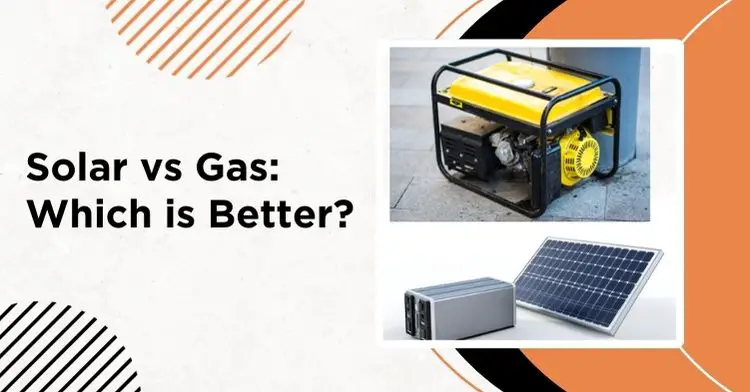
Solar Generator vs Gas Generator for Camping: Complete Comparison Guide
This post contains affiliate links. As an Amazon Associate I earn from qualifying purchases at no extra cost to you.
Solar generator vs gas generator for camping, which is better? Trying to decide between these two options? Both have their place, but choosing the wrong one for your situation can leave you frustrated, either with a dead battery when you need power, or hauling around a noisy, heavy gas generator when you didn’t need to.
This guide breaks down the real differences, costs, and best use cases for each type so you can make the right choice for your camping style.
Contents
- 1 Quick Answer: Which Should You Choose?
- 2 What’s the Difference? (The Basics)
- 3 Head-to-Head Comparison
- 4 Solar Generator: Detailed Pros and Cons
- 5 Gas Generator: Detailed Pros and Cons
- 6 Best Use Cases for Each Type
- 7 The Best of Both Worlds: Hybrid Approach
- 8 Product Recommendations
- 9 Frequently Asked Questions
- 10 Conclusion
- 11 Sources
Quick Answer: Which Should You Choose?
| Choose Solar Generator If… | Choose Gas Generator If… |
|---|---|
| You camp 1-3 days at a time | You need power for 4+ days straight |
| You only need to charge devices and run small appliances | You need to run AC, microwave, or high-draw appliances |
| Quiet operation is important (campground rules) | You’re boondocking in remote areas |
| You want zero maintenance | You need guaranteed power regardless of weather |
| You camp in sunny locations | You camp in cloudy/rainy climates or winter |
The honest answer: For most casual campers doing weekend trips, a solar generator (portable power station) is the better choice. For serious RVers, boondockers, or anyone running an AC unit, a gas generator is still king.
What’s the Difference? (The Basics)
Solar Generators (Portable Power Stations)
Despite the name, “solar generators” don’t actually generate power—they store it. They’re essentially large battery packs (usually lithium-ion or LiFePO4) that you charge at home, in your car, or with solar panels.
How they work:
- Pre-charge at home before your trip (2-8 hours depending on size)
- Use stored power to run devices and appliances
- Optionally recharge with solar panels during your trip
- No fuel, no engine, no emissions, no noise
Popular brands: Jackery, EcoFlow, Bluetti, Anker, Goal Zero
Gas Generators (Traditional Generators)
Gas generators are small engines that burn fuel (gasoline, propane, or both) to generate electricity on demand. As long as you have fuel, you have power.
How they work:
- Fill with gasoline or connect propane tank
- Start the engine (pull cord or electric start)
- Generate continuous power for hours
- Refuel when needed—unlimited runtime potential
Popular brands: Honda, Yamaha, Champion, Westinghouse, Generac
Head-to-Head Comparison
Power Output and Capacity
| Specification | Solar Generator | Gas Generator | Winner |
|---|---|---|---|
| Typical wattage range | 300W – 3,000W | 1,000W – 12,000W | Gas |
| Can run RV AC? | Only largest models ($2,000+) | Yes (3,000W+) | Gas |
| Surge/starting power | Limited (1.5-2x rated) | Excellent (1.5-2x rated) | Gas |
| Runtime | Limited by battery size | Unlimited (with fuel) | Gas |
Bottom line: Gas generators win on raw power. If you need to run high-draw appliances like air conditioners, microwaves, or electric heaters for extended periods, gas is your only realistic option.
Noise Levels
| Generator Type | Noise Level | Comparison |
|---|---|---|
| Solar generator | 0-30 dB | Silent to whisper-quiet |
| Inverter gas generator | 48-65 dB | Conversation to vacuum cleaner |
| Conventional gas generator | 70-85 dB | Lawn mower to motorcycle |
Bottom line: Solar generators are essentially silent. This is their biggest advantage for campgrounds with noise restrictions. If you have a gas generator, learn how to make it quieter or if you simply value peace and quiet.
Weight and Portability
| Capacity/Output | Solar Generator Weight | Gas Generator Weight |
|---|---|---|
| ~1,000W | 20-30 lbs | 25-35 lbs |
| ~2,000W | 40-60 lbs | 45-55 lbs |
| ~3,000W | 70-90 lbs | 80-120 lbs |
Bottom line: Similar weights at comparable capacities, but solar generators are often more compact and don’t require carrying fuel containers.
Upfront Cost
| Capacity | Solar Generator Price | Gas Generator Price |
|---|---|---|
| Entry level (~500-1000Wh) | $300-600 | $300-500 |
| Mid-range (~1000-2000Wh) | $800-1,500 | $500-800 |
| High capacity (~2000-3000Wh) | $1,500-3,000 | $800-1,500 |
| Premium models | $2,500-5,000+ | $1,000-2,500 |
Bottom line: Gas generators are significantly cheaper upfront, especially for higher-capacity models. A quality 3,000W gas inverter generator costs less than a comparable solar generator.
Long-Term Operating Costs
This is where the comparison gets interesting. Let’s look at 5-year costs assuming 50 camping trips:
| Cost Factor | Solar Generator | Gas Generator |
|---|---|---|
| Fuel costs | $0 | $500-1,500 |
| Oil changes | $0 | $100-200 |
| Maintenance/repairs | Minimal ($0-100) | $200-500 |
| Battery replacement | $0 (10+ year lifespan) | N/A |
| 5-Year Operating Cost | $0-100 | $800-2,200 |
Bottom line: Solar generators have near-zero operating costs. Over 5-10 years, the higher upfront cost is often offset by fuel and maintenance savings.
Safety Considerations
| Safety Factor | Solar Generator | Gas Generator |
|---|---|---|
| Carbon monoxide risk | None | Yes – must use outdoors |
| Fire risk | Very low | Moderate (fuel storage) |
| Can use inside tent/RV? | Yes | No – never |
| Hot surfaces | Cool operation | Hot exhaust and engine |
| Fuel spill risk | None | Yes |
Bottom line: Solar generators are inherently safer. No fuel, no fumes, no hot surfaces, and you can use them inside your tent or RV without any risk.
Solar Generator: Detailed Pros and Cons

Pros
- Zero noise: Perfect for quiet campgrounds and national parks
- No emissions: Environmentally friendly and safe for indoor use
- No maintenance: No oil changes, spark plugs, or fuel stabilizer needed
- Free fuel (solar): Recharge from the sun at no cost
- Clean power: Pure sine wave output is safe for all electronics
- Easy to use: Just press a button – no pull cords or priming
- Long lifespan: LiFePO4 batteries last 3,000+ charge cycles (10+ years)
- Allowed everywhere: No restrictions at campgrounds that ban generators

Cons
- Limited capacity: Once the battery is depleted, you are out of power
- Slow recharging: Solar panels take 4-8+ hours for a full charge in good sun
- Weather dependent: Cloudy days and winter significantly reduce solar charging
- High upfront cost: Comparable capacity costs 2-3x more than gas
- Cannot run high-draw appliances: Forget about AC units with most models
- Battery degradation: Capacity slowly decreases over years of use
Gas Generator: Detailed Pros and Cons
Pros
- Unlimited runtime: As long as you have fuel, you have power
- High power output: Easily run AC units, microwaves, and power tools
- Lower upfront cost: More watts per dollar than solar generators
- Weather independent: Works in any weather, day or night
- Reliable: Proven technology with decades of refinement
- Wide availability: Fuel is available almost everywhere
Cons
- Noise: Even quiet inverter models are audible at 50+ dB
- Carbon monoxide danger: Must always be used outdoors with proper ventilation
- Fuel hassles: Need to buy, transport, and store gasoline
- Maintenance required: Oil changes, spark plugs, air filters, fuel stabilizer
- Campground restrictions: Many parks limit or prohibit generator use
- Fuel costs: Ongoing expense, especially at current gas prices
- Weight: Heavy, especially when including fuel containers
Best Use Cases for Each Type
When Solar Generators Excel
Weekend tent camping: A 500-1000Wh solar generator easily handles 2-3 days of phone charging, LED lights, a small fan, and a portable fridge. Completely silent operation means no disturbing your neighbors or the wildlife.
Car camping with minimal needs: If you’re not running an AC or microwave, a mid-sized power station covers all your needs with zero hassle. Charge it at home, use it all weekend, charge it again when you get back.
National parks and quiet campgrounds: Many parks have strict noise policies or outright generator bans. A solar generator lets you have power without breaking rules or getting complaints.
CPAP users: A 500Wh power station runs a CPAP machine for 2-3 nights without recharging. Silent operation won’t disturb your sleep.
Photographers/content creators: Charge cameras, laptops, and drones without noise that ruins video audio or scares wildlife.
When Gas Generators Excel
Extended boondocking: Off-grid for a week or more? A gas generator with enough fuel provides reliable power regardless of how cloudy it gets or how much power you use.
Running RV air conditioning: A 13,500 BTU RV AC requires 2,800-3,500 starting watts. (See our generator sizing guide for exact calculations.) While some premium solar generators can handle this, they’ll drain in 1-2 hours. A gas generator runs AC all day long.
Power-hungry setups: Electric heaters, microwaves, coffee makers, and hair dryers all draw 1,000-1,800 watts. A gas generator handles these easily; most solar generators can’t.
Emergency backup: During power outages, a gas generator can power essential home appliances for days. Solar generators typically last 4-12 hours under moderate load.
Winter camping: Cold weather reduces battery efficiency and solar charging is minimal with short days. Gas generators perform consistently regardless of temperature.
The Best of Both Worlds: Hybrid Approach
Many experienced campers use both types of generators together. Here’s how:
Strategy 1: Solar for daily use, gas for backup
- Use your solar generator for regular charging and small appliances
- Bring a gas generator for running AC during heat waves or as emergency backup
- Best for: RVers who sometimes need AC but not always
Strategy 2: Gas generator to charge solar battery
- Run the gas generator for 1-2 hours in the morning to charge your power station
- Use the power station silently for the rest of the day
- Best for: Campgrounds with generator hour restrictions
Strategy 3: Size each for different scenarios
- Small solar generator (500Wh) for weekend tent camping
- Gas generator (3,000W) for extended RV trips
- Best for: Families with varied camping styles
Product Recommendations
Best Solar Generators for Camping
Budget pick: Jackery Explorer 300 (~$300) – 293Wh capacity, 300W output, perfect for charging devices and running small lights. Weighs only 7.5 lbs.
Best value: Anker Solix C1000 (~$1,000) – 1,056Wh capacity, 1,800W output. Great balance of power, portability, and price. Runs small appliances easily.
Premium pick: EcoFlow Delta 2 Max (~$2,000) – 2,048Wh capacity, 2,400W output (4,800W surge). Can actually run small AC units briefly. Expandable to 6kWh.
Best Gas Generators for Camping
Budget pick: Champion 2500W Inverter (~$500) – Quiet operation at 53 dB, dual fuel capable. Great value for the features.
Best value: Honda EU2200i (~$1,100) – The gold standard for portable generators. Ultra-quiet at 48-57 dB, bulletproof reliability, excellent fuel efficiency.
For running AC: Champion 4500W Dual Fuel (~$1,000) – Enough power for RV AC units, runs on gas or propane, quiet for its size at 61 dB.
Frequently Asked Questions
Can a solar generator run an RV air conditioner?
Only the largest and most expensive models (2,000W+ output, 2,000Wh+ capacity) can run a small RV AC, and only for 1-2 hours. For continuous AC use, a gas generator is the practical choice.
How long does a solar generator last on one charge?
It depends entirely on what you’re running. A 1,000Wh power station can run a 50W mini-fridge for about 20 hours, charge 80+ phones, or run a 100W laptop for 10 hours. Running a 1,500W appliance would drain it in about 40 minutes.
Are solar generators allowed in national parks?
Yes! Since they produce no noise or emissions, solar generators (portable power stations) are allowed everywhere. Gas generators are often restricted to specific hours or prohibited entirely in national parks.
Can I charge a solar generator while driving?
Yes, most solar generators can charge from a 12V car outlet while you drive. Depending on the model and your vehicle’s electrical system, you can add 50-200 watts of charging per hour of driving.
Which lasts longer—a solar generator or gas generator?
Solar generators with LiFePO4 batteries are rated for 3,000+ charge cycles (10-15 years of regular use). Quality gas generators can last 10,000+ hours with proper maintenance, which could be 20+ years for occasional camping use. Both can last a very long time if treated well.
Conclusion
For most weekend campers: A mid-sized solar generator (1,000-2,000Wh) is the better choice. The convenience of silent, maintenance-free operation outweighs the higher upfront cost, and you’ll never deal with fuel, noise complaints, or generator restrictions.
For serious RVers and boondockers: A quality gas inverter generator is still the practical choice. Nothing else provides the combination of high power output, unlimited runtime, and weather-independent operation needed for extended off-grid living.
The smart move: If you camp frequently and your needs vary, consider having both. A small solar generator for easy weekend trips and a gas generator for times when you need serious power. The combined cost is less than one premium solar generator, and you’ll have the right tool for every situation.
Now you understand the full solar generator vs gas generator for camping comparison. The right choice depends on your camping style, power needs, and priorities—whether that’s silence, unlimited runtime, or zero maintenance.
Sources
- Consumer Reports – Portable Generator and Power Station Testing
- EcoFlow – Solar vs Gas Generator Comparison
- Jackery – Portable Power Station Specifications
- Honda – EU2200i Specifications and Testing
- National Park Service – Generator Policies
Need specific recommendations? See our Top 8 Quiet Generators for RVs.